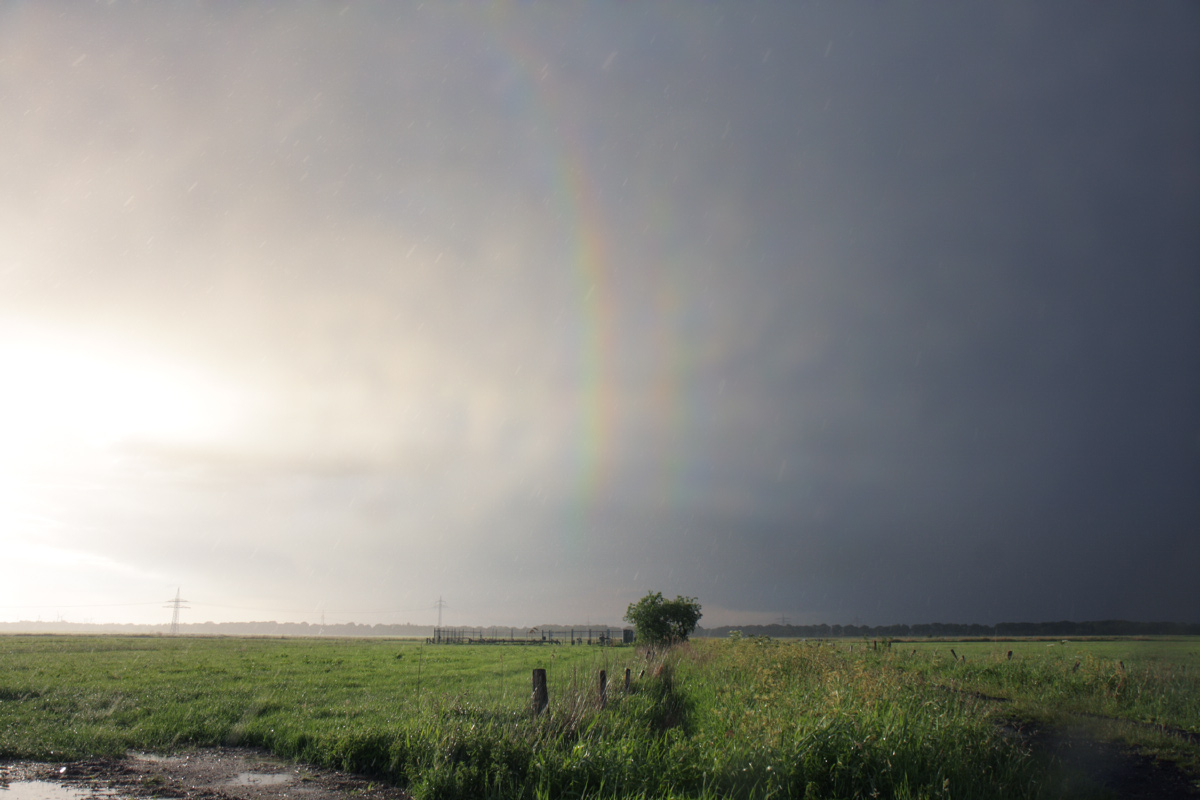
Who doesn't know it, the colorful arc after or during a rain shower, which can take up a large part opposite the sun and is fascinating to look at. Sometimes you can even see a second, weaker arc outside the first one, but with reversed color order. These two are called the primary and secondary rainbow.
Primary means that the incoming light is once reflected inside the drop, split into its spectral colors, and exits the drop again. In the case of the secondary rainbow, this internal reflection happens twice. This double reflection is also the reason why the color sequence is inverted compared to the primary rainbow.
Now the question arises whether this internal reflection can occur once more in the drop; and indeed it can! Here we have reached the point where we speak of "higher order".
Higher order does not mean that the rainbow takes a higher position in the sky. It rather indicates the number of internal reflections that go beyond the two we know. We distinguish as follows:
- 0th order: Light transmission through the drop / "Zero order glow"
- 1st order: primary rainbow
- 2nd order: secondary rainbow
- 3rd order: tertiary rainbow
- 4th order: quaternary rainbow
- 5th order: quinary rainbow
- 6th order: senary rainbow
- and so on...
The primary and secondary rainbow are opposite the sun, with the exit angle of the main rainbow, relative to the entry angle, being about 138°. For the secondary bow, it is about 128°. The tertiary and quaternary rainbows have exit angles of about 40° and 45°, respectively. This means they are close together and arise in relation to the light entry angle towards the sun.
The quinary and senary bows are again related to the light entry angle to find the area opposite to the sun, with the quinary bow overlapping the secondary bow with an exit angle of about 130°. The senary bow, with an exit angle of about 145°, is still within the bright caustic disc of the primary main rainbow.
A multitude of rainbows can theoretically be formed, all appearing at different positions in the sky. However, there are several factors to consider that can hinder, if not make it impossible, to observe them.
- With each internal reflection, light also leaves the droplet, so the intensity of the rainbow decreases with increasing order.
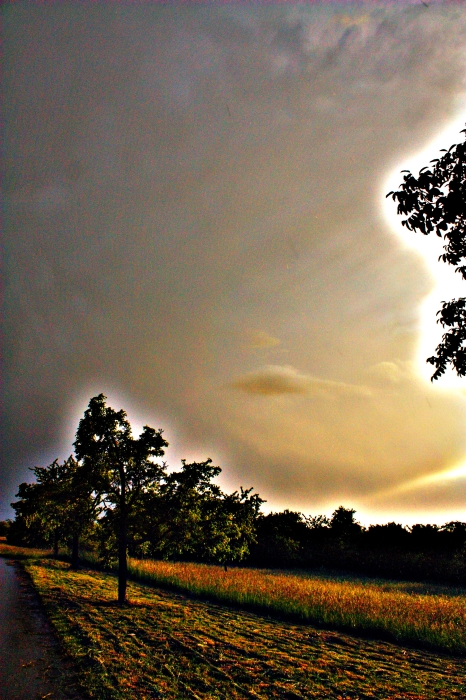
- Rainbows that form towards the sun (3rd and 4th order) are barely to not at all observable with the naked eye due to the intense glare of the sun and the resulting high contrast range.
- Additionally, the exiting color spectrum becomes not only weaker in color with increasing order, but the width of the rainbow steadily increases. This makes the color contrast between the background and the rainbow itself increasingly indistinct.
To achieve a successful observation or photographic proof, some tips and assistance are needed.
- Compare weather and rain radar maps for the current weather situation
- The shots should be taken in an uncompressed format (RAW)
- Use polarizing filters if possible
- Cover the sun to avoid lens flares
- Take series of shots if possible
- Protect the camera lens from rain
After a successful observation, the shots must be evaluated. Through image processing, usually using the
unsharp mask, the sighting can be clearly confirmed.
Text: Michael Großmann