Description
The origin of elliptical rings has not yet been fully clarified.

Crystal Type:
- unknown
- unknown
- unknown
Occurrence:
- very rare
When fall streaks descend from middle level clouds such as altocumulus, white elliptical rings can occasionally form. The rings are elongated vertically. Their size and shape change with the solar altitude. Due to their close proximity to the sun, usually 6° or less, observation and photography are greatly hindered, as this area is strongly outshone by the sun. Therefore, it is difficult to say how rare elliptical rings really are. One or two rings of varying diameters are most frequently observed. Very rarely, more rings can form. In Finland, elliptical displays with four or five rings have been observed (five rings on 25.06.1996 by Mika Sillanpää). An early example is the ring observed by C. W. Hissink on 28 June 1901 in Zutphen, which is also known as Hissink's halo.
Origin
According to the currently preferred model, elliptical rings are formed by refraction in plate crystals with very flat, obtuse pyramidal faces. Because these faces are only slightly inclined, the rings lie very close to the sun and are elongated vertically. However, with this type of halo, the simulations do not entirely match the observed rings, so further investigation is needed here. In addition, the pyramid model requires very small face inclinations that are difficult to explain physically. An older model explains the rings by reflection on two oscillating crystals. Elliptical rings are related to Bottlinger's rings around the subsun.
Photos
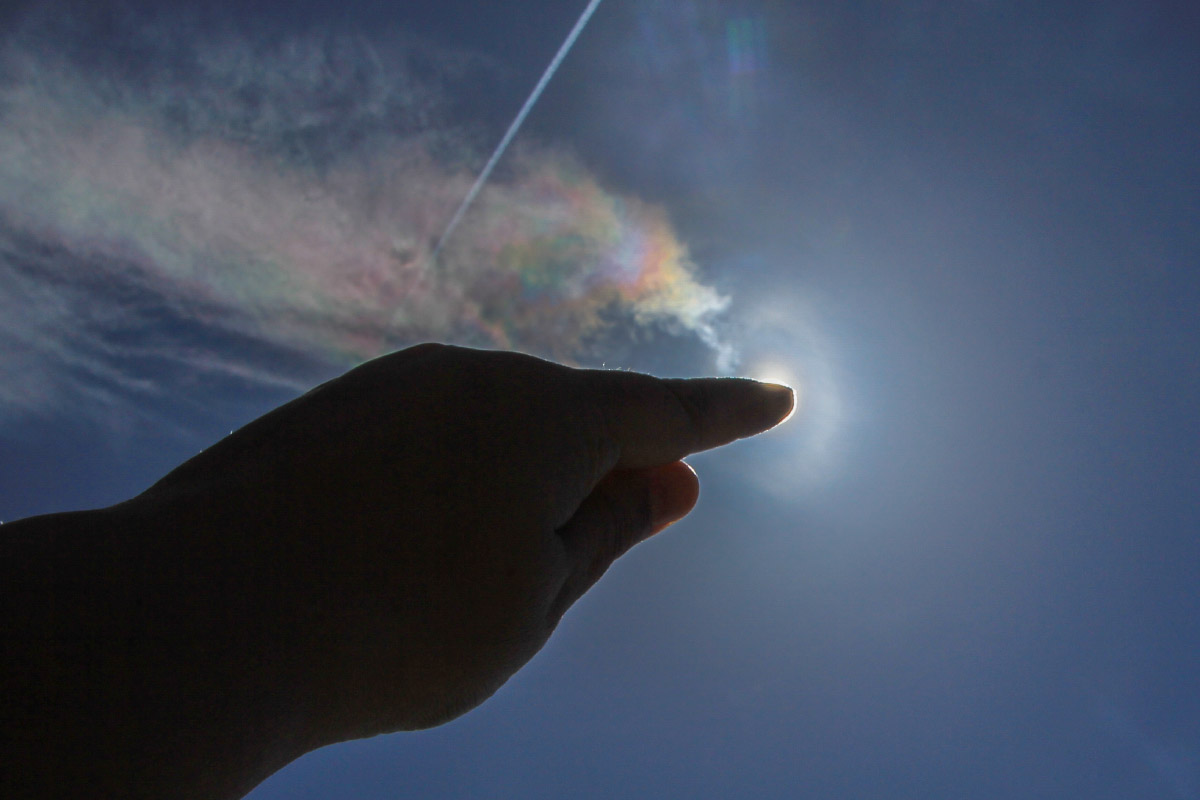
Elliptical halo together with iridescent clouds on 22.04.2016 (Photo: Claudia Hinz)

Elliptical Halo in Ice Mist taken on 13.03.2006 at Wendelstein (Photo: Claudia Hinz)
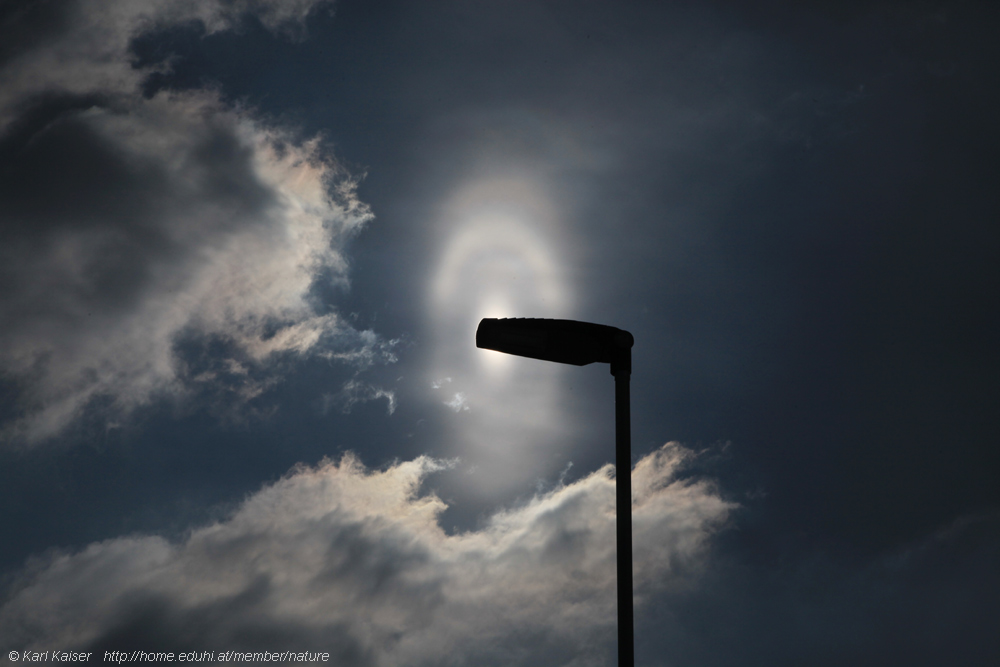
Elliptical halo seen on 21.02.2018 (Photo: Karl Kaiser)