Description
Crystal type:- Plate crystals, also column crystals
Orientation:Light path:- Refraction at 2 side surfaces
Occurrence:
Lowitz arcs are a group of relatively rare halos that appear outside the
22° ring. Their shape is highly dependent on the sun's altitude. EE14 refers to Lowitz arcs on the left side, EE15 on the right side, and EE16 the occurrence on both sides.
On June 18, 1790, Johann Tobias Lowitz observed in St. Petersburg colored short arc pieces which extended from the
parhelia colored diagonally upwards and downwards to the 22° ring . In today's halo key, this historical sighting falls into the category EE16B (bilateral lower lateral Lowitz arcs). The existence of the Lowitz arcs was doubted until the 1990s.
Around 1980, Robert Greenler conducted numerical simulations of these arcs, additionally identifying two further ray paths. These in the simulation created new halos not yet observed.
On August 11, 1985, Jens Fröhlich observed a reddish arc in Knau (Thuringia) that extended from the vertex of the
Parry arc bilaterally downwards into the 22° ring. After further observations in Germany and Finland, this was identified in comparison with Greenler's predictions and additional simulations by Eberhard Tränkle in the mid-1990s as one of the previously unknown Lowitz arcs, whereupon it was named the "upper circular Lowitz arc" (EE14C-16C) due to its shape.
In English literature, influenced by Greenler's theory, Lowitz arcs are classified according to ray paths into upper (U), middle (M), and lower (L) Lowitz arcs. According to this theory, all Lowitz arcs cross a 22° parhelion (or both).
Move the slider to change the solar elevation.
Move the slider to change the solar elevation.
- Upper Lowitz Arc (U)
- Lower Lowitz Arc (L)
- Middle Lowitz Arc (M)
Classification of the Arbeitskreis Meteore e.V.
However, the classification of the Arbeitskreis Meteore e.V. is less oriented towards theory and more towards the appearance of halos in nature. This ensures continuity within the statistics, independent of theoretical developments. In this classification scheme, there are initially the
upper lateral Lowitz arcs (EE14A-16A) as connections starting from the 22° parhelion slanting upwards to the 22° halo. These are parts of the arc belonging to the U-ray path. The arcs that tangentially run downward from the parhelion to the 22° halo are referred to as
lower lateral Lowitz arcs (EE14B-16B) and are generated by the L-ray path. Both halo subtypes (A and B) can, when extraordinarily well developed, extend "backwards" beyond the parhelia downwards or upwards.
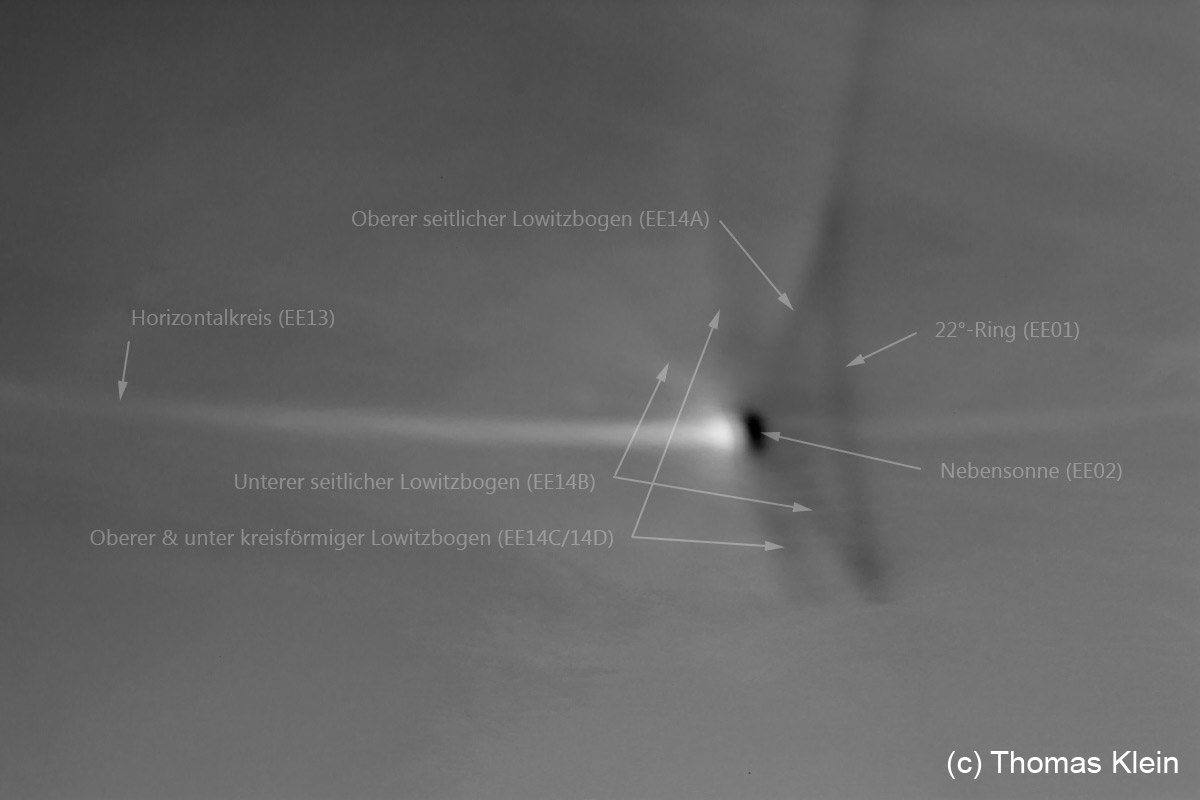
The following photo shows the Lowitz arcs in the area of the left parhelion. It was taken on
01.11.2014 by Thomas Klein in Miesbach.

Lowitz arcs in the area of the left sundog - edited (Photo: Thomas Klein)
The upper circular Lowitz arc (EE14C-16C) is either part of the U-light path (when touching the concave Parry arc EE27A above the sun) or the M-light path (when touching the convex Parry arc EE27C). Typically, the latter occurs at lower solar altitudes (< 10°). At higher solar altitudes (around 25°), only short arc sections from the M-light path remain near the sundogs, which intersect these approximately parallel to the 22° ring, i.e., without a tendency to touch (See image from above). In this case, to distinguish them from the usually simultaneously present EE14A-16A and B, they are also referred to as circular Lowitz arcs, specifically labeled as EE14C-16C above the sundog and as EE14D-16D below.
Move the slider to change the solar elevation.
Description of the Lowitz arcs according to the observations of the AKM
- EE14A/15A - Upper Lateral Lowitz Arc
- EE14B/15B - Lower Lateral Lowitz Arc
- EE14C/15C - Upper Circular Lowitz Arc
- EE14D/15D - Lower Circular Lowitz Arc
- EE14E/15E - Reflected Lowitz Arcs
The subcategory EE14E-16E forms the reflected Lowitz arcs, also known as "Schulthess's arcs." These arise analogously to the above-described "normal" Lowitz arcs, but with an additional reflection on a prism deck surface. Thus, there are also three possible ray paths (RU for "reflected upper", RM and RL), which now intersect not in the parhelion, but in the subparhelion. Observing this intersection would, however, require sufficient crystals below the horizon. Due to the extreme rarity of this halo subtype, further subdivision is omitted in the context of the halo key.
Lowitz arcs are primarily observed at low solar altitudes below 35°, with reflected Lowitz arcs mostly under 20°. The side arc pieces are most frequently seen. The upper circular Lowitz arc is rare, and the even rarer reflected Lowitz arcs occur mainly in ice fog. The best chances of seeing the upper Lowitz arc (U) are at solar altitudes of 15° to 30°, in the region between the upper tangent arc and the Parry arc. It always touches the concave Parry arc.
Origin
The most widespread explanation of the formation of Lowitz arcs is the theory originally put forward by R. Greenler, based on
rotating plates with a horizontal axis that lies in the basal plane and runs through two opposite prism edges (Lowitz axis). In this case, the rays pass through the crystal between two prism side faces inclined at 60° in the three different possible ray paths.
This makes it possible to reproduce the positions of the observed Lowitz arcs well, but the brightness distributions within individual arcs and among the Lowitz components do not always match the observations. More recently, simulations showed that irregular hexagonal crystals with restricted rotation about the Lowitz axis reproduce the observed brightness better. For example, it is conceivable that the plates do not complete a full 360° rotation but instead swing along a horizontal axis around the parhelic orientation. This would make only Lowitz arc segments visible around the parhelion. Likewise, columns in Parry orientation can swing about a horizontal axis perpendicular to their long axis. This axis runs through two opposite prism edges. This produces the Lowitz components near the Parry arcs.
The possibility of an additional reflection on a prism end face was already pointed out in the description of the reflected Lowitz arcs.