The meteorite fall of Flensburg on 12 September 2019
Classification: Carbonaceous chondrite, C1 ungrouped, weathering grade W0 Fall: 12 September 2019, 14:49:48 CEST (12:49:48 UT) Location: Flensburg, Schleswig-Holstein Finds: 1 stone, 24.5 g
Flensburg is one of the most unusual meteorites ever to have fallen in Germany. The small stone of only 24.5 g consists almost entirely of minerals that formed with the involvement of water. It belongs to no known meteorite group and comes from a parent body of its own, of which there are no other samples. Its carbonates are the oldest dated so far in a chondrite. It was not found by a targeted search but by chance in a front garden, one day after the fall.
Fireball in broad daylight
In the early afternoon of 12 September 2019 a very bright fireball crossed northern Germany. It was clearly visible even in daylight. The International Meteor Organization (IMO) received 584 eyewitness reports. Most of them came from the Netherlands, where the weather was best. Further observations came from northern Germany, Belgium and Denmark. The most distant sighting came from England, more than 600 km from the fireball. The Bremen rescue coordination center of the German Maritime Search and Rescue Service received reports from ships in the North Sea. It initially took the phenomenon for a distress signal between Langeoog and Spiekeroog and sent out two rescue boats.
The satellite sensors of the US government also detected the bolide. They provided the exact time of maximum brightness (12:49:48 UT) and a total energy of 0.48 kt TNT. Location and speed, however, were determined only imprecisely. The sky over large parts of Germany was cloudy, and the fireball appeared in broad daylight. There were therefore no photographs from the fireball network. Jiří Borovička and colleagues from the Astronomical Institute in Ondřejov therefore determined the trajectory from four videos:
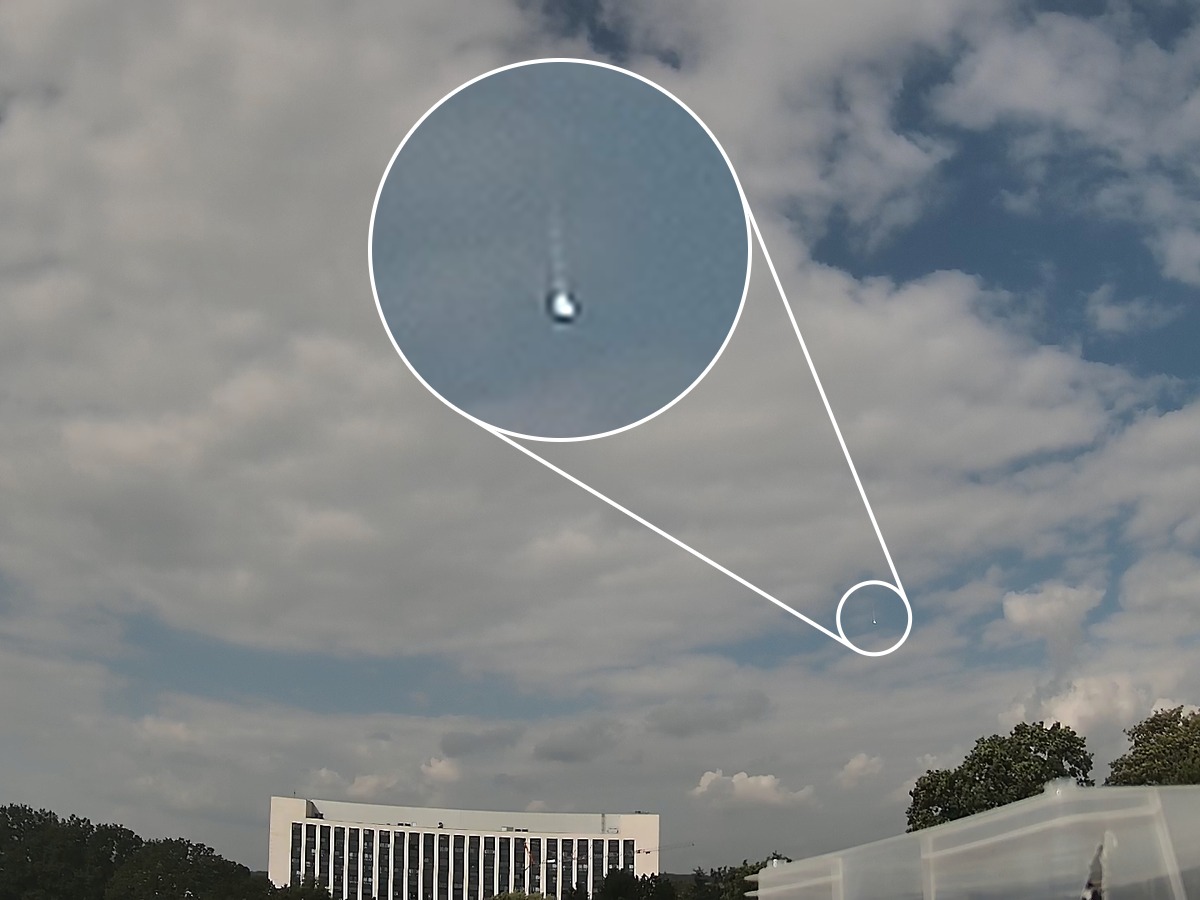
The AllSky6 meteor camera in Herford recorded about one second of the luminous path through a gap in the clouds. As the camera is fixed, it could be calibrated precisely using stars from other nights.
Three dashboard cameras in Nijmegen, Almere (both Netherlands) and on Rügen filmed the bolide by chance. Felix Bettonvil and Gerd Baumgarten later drove to the same places and recorded the star fields there at night. This made it possible to measure these videos as well. Only the video from Nijmegen shows the end of the luminous path.
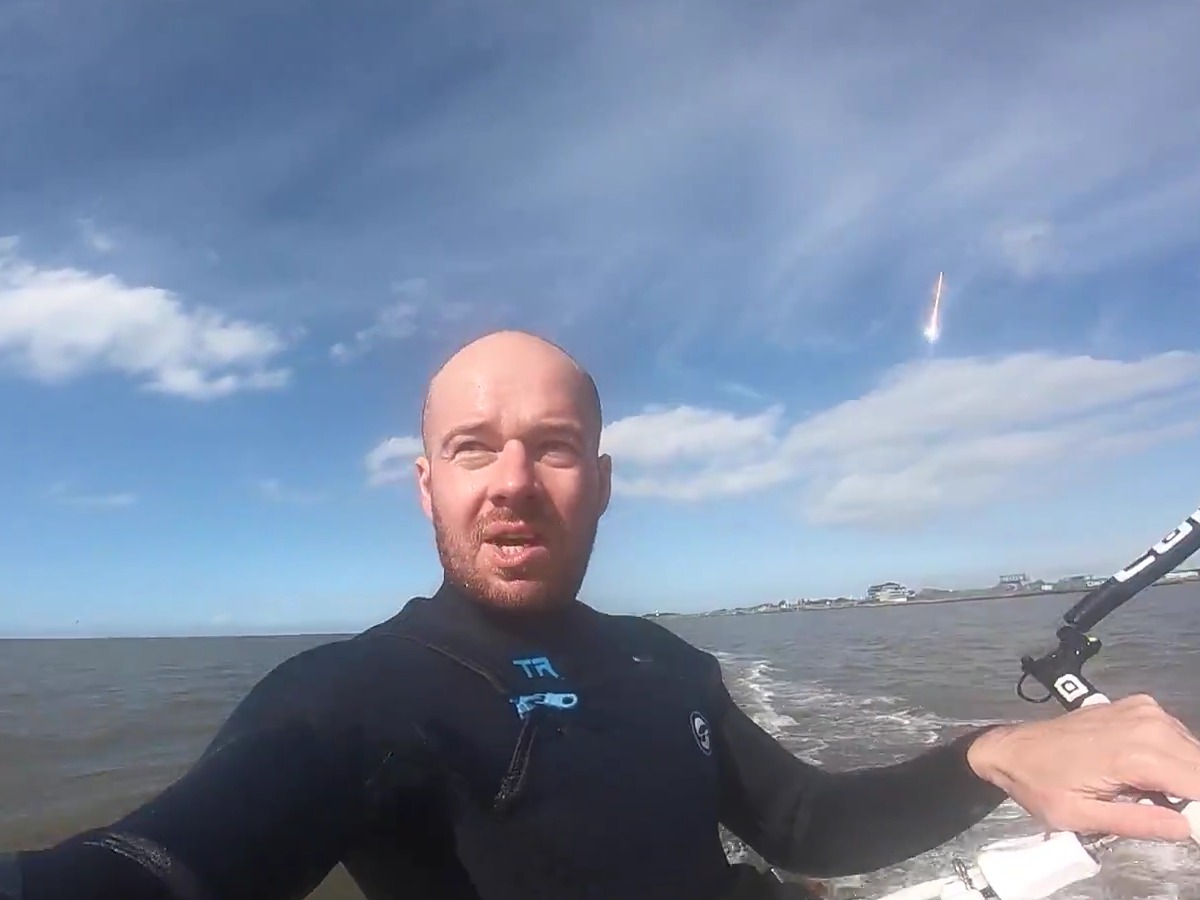
Further videos were not included in the trajectory calculation. One of them was made entirely by chance. The 32 year old kitesurfer Dorian Cieloch from Bremerhaven was filming that afternoon at the mouth of the Weser near Wremen, north of Bremerhaven. The location is about 106 km south southwest of the point where the fireball was brightest. In his video the bolide can be seen for about two seconds at the top right of the picture, above the Hotel Deichgraf. Cieloch himself noticed nothing. He heard no bang and saw the fireball neither while filming nor while editing the video. Only after he had posted the film on the internet did the first comment point out the "meteor" in his recording. The day after the fall the NDR already reported on him in its television news.
Another video was taken on a boat off Wangerooge. It shows the disintegration of the body.
AMS21 Herford (Photo: Jörg Strunk)
Kitesurfer with fireball (Photo: Dorian Cieloch)
The bolide appeared over the mouth of the Elbe and flew almost exactly north. In daylight a fireball becomes visible late and disappears early. At night the luminous path would therefore probably have been seen to start at a greater height and end somewhat lower. Between 46 and 37 km altitude the body broke up almost completely. The dynamic pressure acting on it was 0.7 to 2 MPa. The recordings show no large fragments, but a trail of small particles and dust.
Before the collision the meteoroid orbited the Sun on an orbit with a semi major axis of 2.82 AU. At perihelion it came as close as 0.84 AU to the Sun, at aphelion it moved as far as 4.8 AU away. The inclination of the orbit was 6.8°, the orbital period 4.7 years. The orbit was thus in the 5:2 resonance with Jupiter: for every five orbits of the meteoroid Jupiter completed two. Such a resonance can quickly change the orbit of an asteroid so that it crosses the Earth's orbit.
Quantity
Value
Start of the luminous path
71.8 km altitude
Maximum brightness
about 41 km altitude
End of the luminous path
35.3 km altitude
Entry velocity
19.43 km/s
Inclination to the horizon
24.4°
Length of the observed luminous path
90 km
Duration
about 4.5 seconds
Entry mass
about 10 to 20 t
Diameter before entry
about 2 to 3 m
Find and search
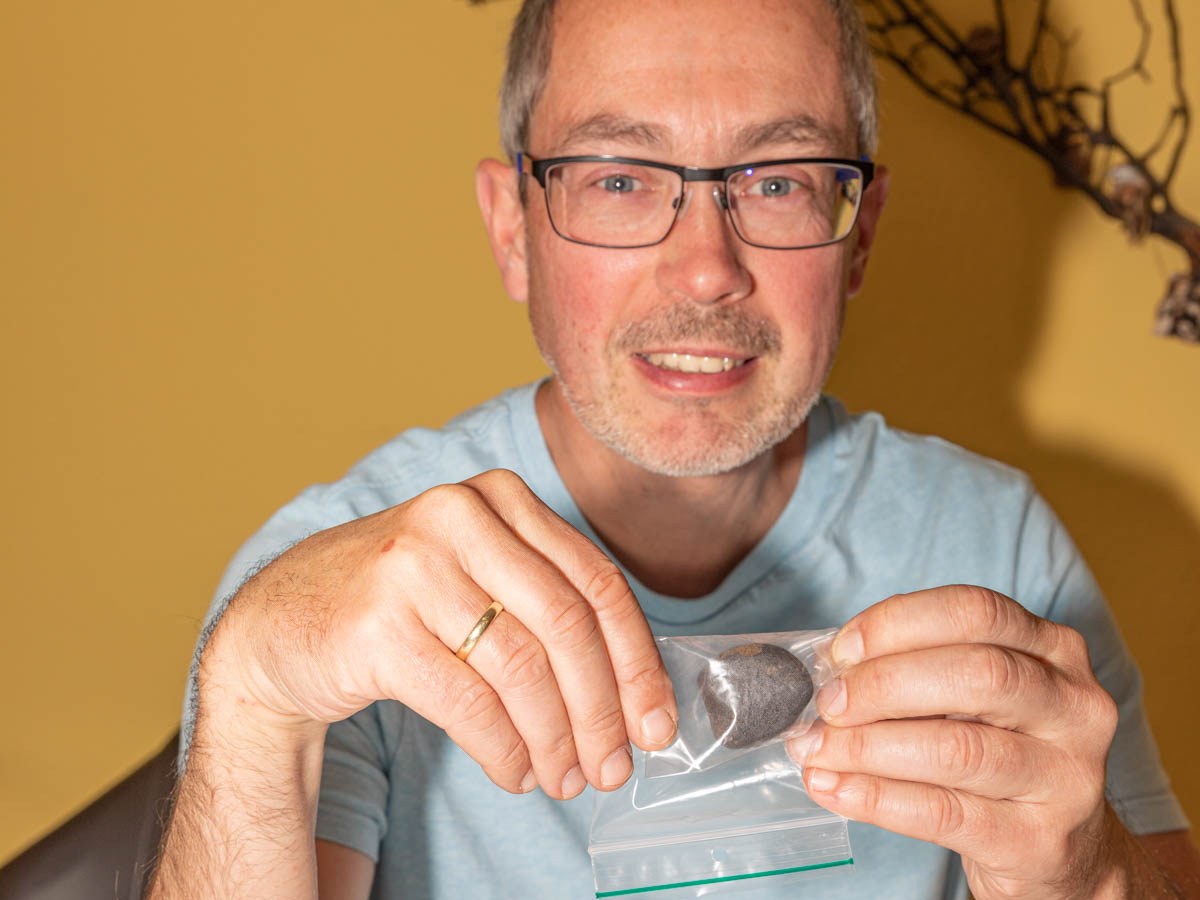
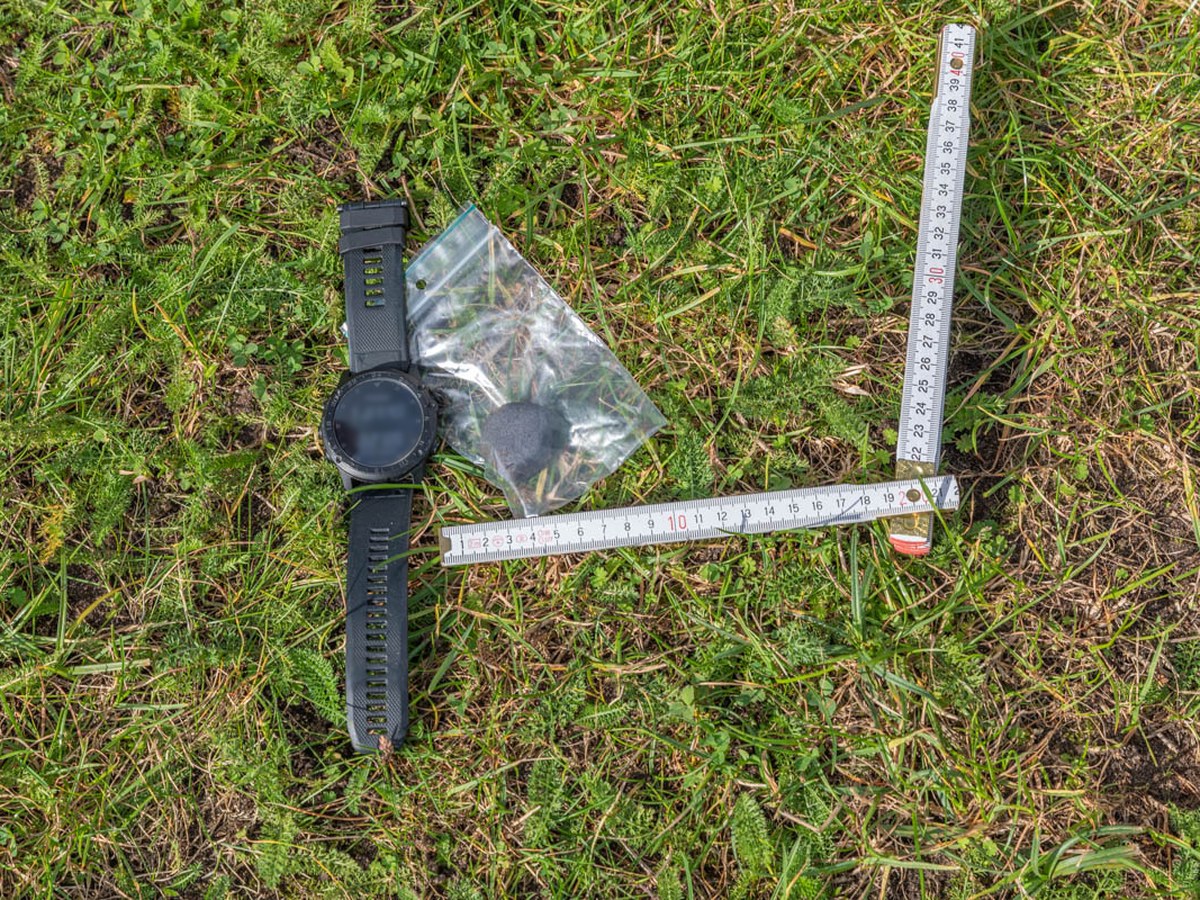
On Friday, 13 September 2019, at around 11:00 Erik Due-Hansen wanted to mow the lawn in his front garden in the south west of Flensburg. Beforehand he cleared toys and other things from the lawn. In doing so he discovered a black, strikingly light stone about three centimeters in size with fine cracks in the middle of the lawn. He noticed that the stone lay on top of the grass and was not embedded in the ground. He remembered the news about the fireball of the previous day and suspected that the stone had fallen from the sky. Between the fall and the find a few millimeters of rain had fallen in Flensburg.
At the weekend Due-Hansen showed the stone to his father in Denmark and to some friends. He tested it with a strong magnet, and the stone reacted. On 15 September he reported the find via the IMO form and sent four photos to Mike Hankey of the American Meteor Society. Hankey contacted the Arbeitskreis Meteore and Dieter Heinlein, the coordinator of the German fireball network at the DLR.
On 27 September Laura Kranich and Carsten Jonas from Kiel, both members of the Arbeitskreis Meteore, visited the finder and his wife. They measured the find location, documented the circumstances and interviewed the couple. Due-Hansen handed the stone over to them, and they immediately sent it by post to Dieter Heinlein in Augsburg.
Erik Due-Hansen, finder of the Flensburg meteorite (Photo: Carsten Jonas)
Find location of the meteorite (Photo: Carsten Jonas)
From mid September onwards, members of the Arbeitskreis Meteore, among them Andreas Möller, Laura Kranich, Carsten Jonas, Sirko Molau and Jörg Strunk, searched for further pieces. Several groups had calculated their own strewn fields. Their results differed from each other. A reliable trajectory was only available once the videos had been carefully calibrated. Systematic searches took place in the second half of November 2019 and in February 2020. No further meteorites were found.
This is surprising, because judging by the mass of the meteoroid hundreds of stones of about 10 g and tens of thousands of about 1 g could have fallen. Borovička and colleagues give two possible reasons. Perhaps only about 3 % of the mass reached an altitude of 37 km, and most small pieces disintegrated during the dark flight. Or many meteorites did fall but disintegrated quickly in the humid climate. The stone that was found was recovered after only one day, whereas the systematic search only began two months later.
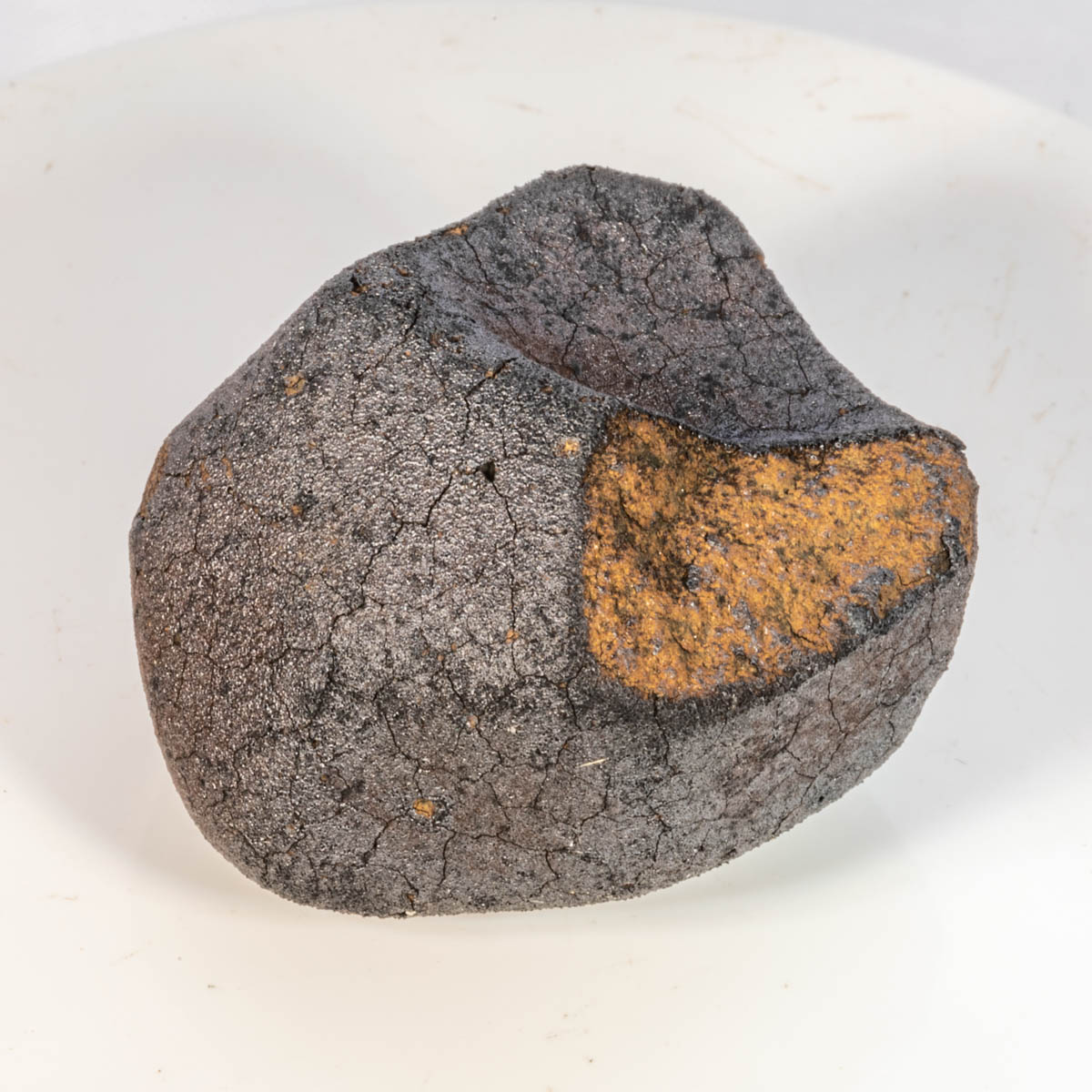
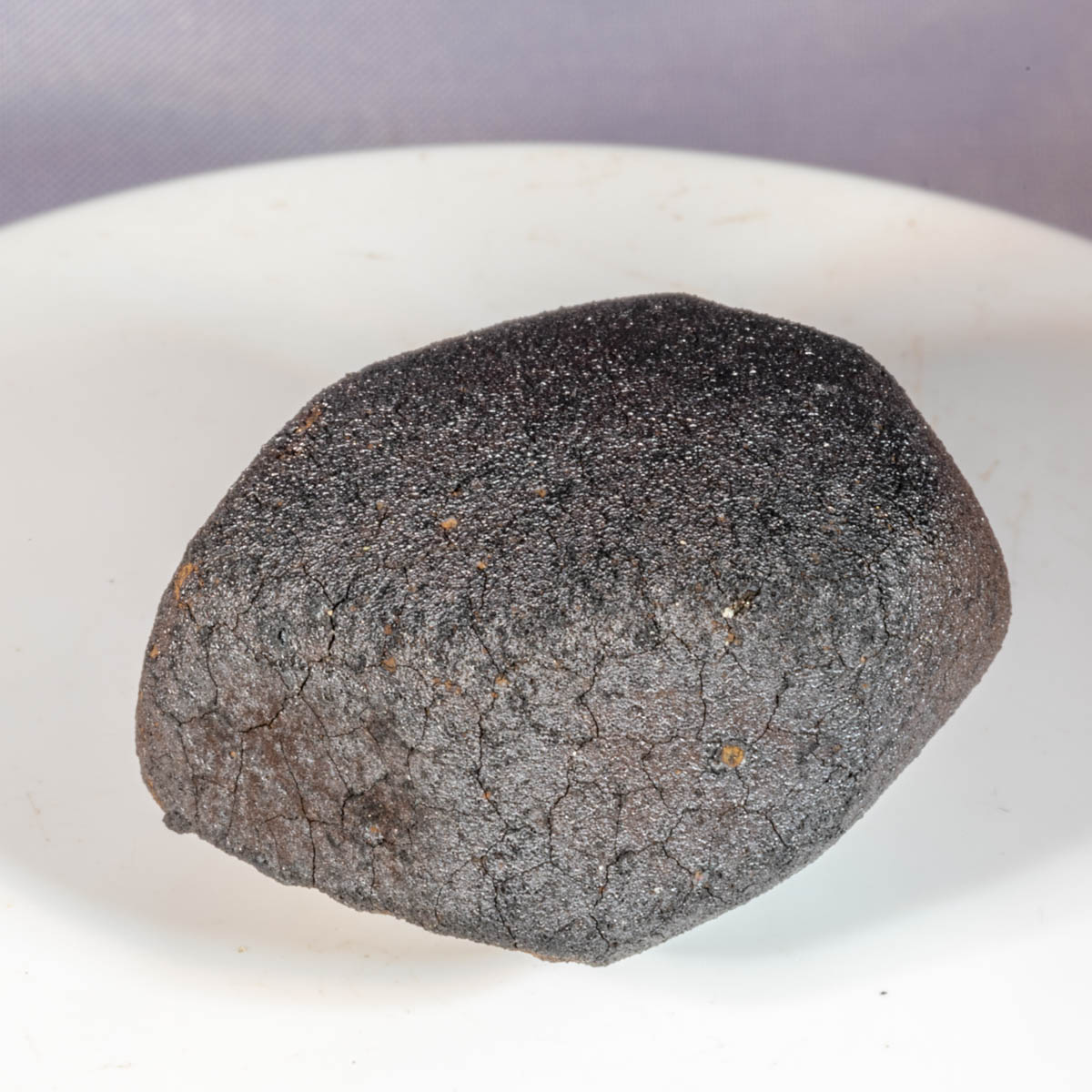
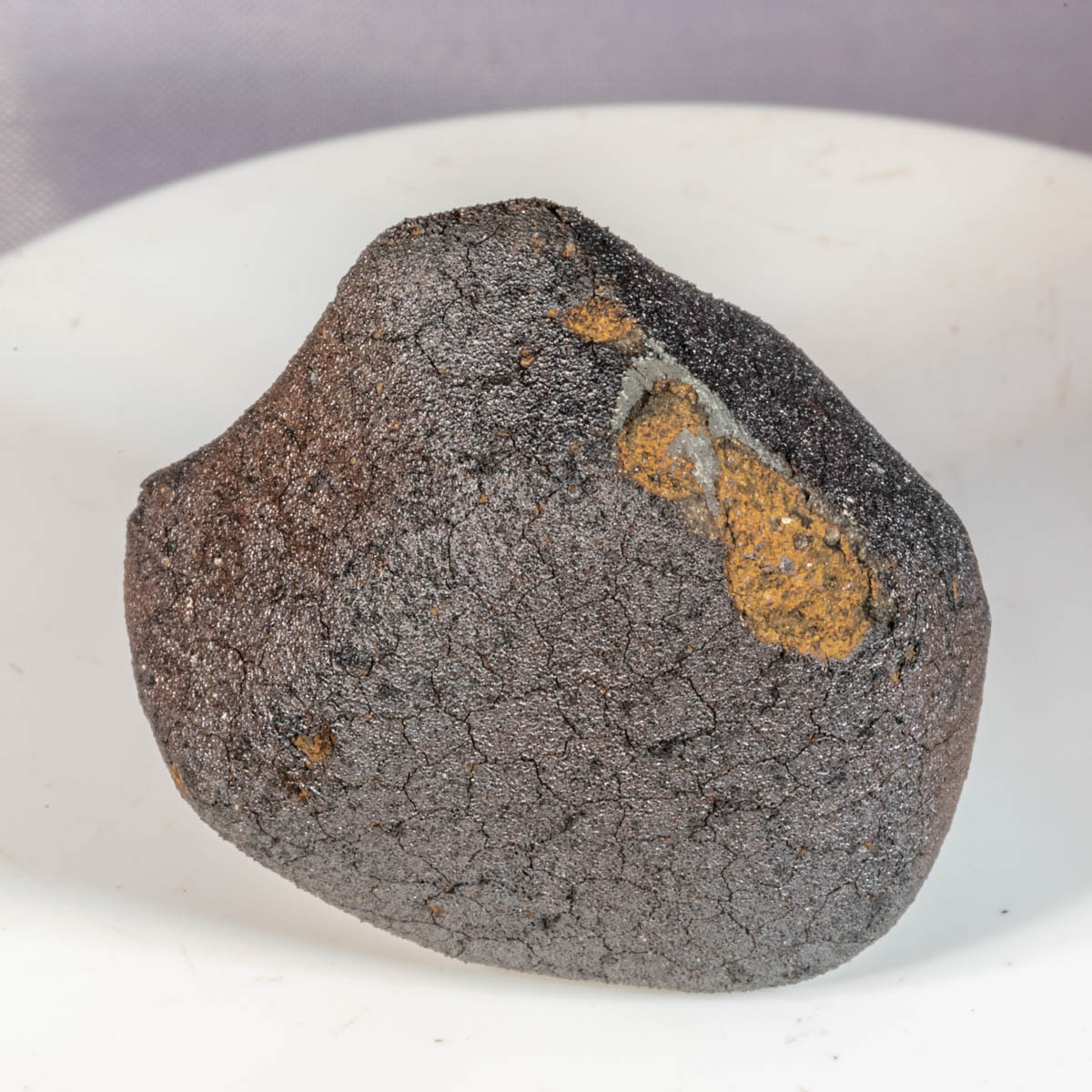
The Flensburg meteorite (Photo: Carsten Jonas)
First investigations
First the stone was examined non destructively. In the underground laboratory Felsenkeller of the VKTA in Dresden, Detlev Degering measured its weak radioactivity for two and a half weeks. The stone arrived there about one month after the fall. Ten short lived cosmogenic radionuclides were detected, some with half lives of a few weeks. This made it clear that the stone had come fresh from space and belonged to the fireball. A high resolution computed tomography was made at the Helmholtz Institute Freiberg.
On 11 November 2019 the stone arrived at the Institute of Planetology of the University of Münster. Addi Bischoff and his doctoral student Markus Patzek sawed it into two parts of 17.03 g and 6.54 g and carried out the classification. The Nomenclature Committee of the Meteoritical Society approved the name "Flensburg" on 5 February 2020. Bischoff and 40 coauthors published a comprehensive study in 2021.
The stone measures about 3.5 x 3.2 x 2.4 cm. It is covered by a fresh black fusion crust with many shrinkage cracks. In some places the first crust has flaked off. There a thin, brownish second fusion crust has formed. These parts must therefore have come off while still in the atmosphere. A small scratch shows that the stone grazed a hard surface before landing on the lawn. Its density is only 1.98 g/cm³. According to an estimate by Szurgot, about 30 % of the rock is pore space.
Mineralogy, age and origin
The rock consists of relict chondrules and clusters of sulfide and magnetite in a dark, fine grained matrix. The chondrules are 0.05 to 1 mm in size, on average about 0.15 mm. They no longer contain olivine or pyroxene. These anhydrous minerals have been completely converted into phyllosilicates, mainly serpentine. The phyllosilicates make up about 90 percent by volume. In addition there are carbonates (3.9 %), sulfides (3.8 %) and magnetite (1.9 %). The carbonates include calcite, dolomite and a rare sodium rich carbonate. Dennis Harries later identified it as shortite. This was the first time this mineral was detected in extraterrestrial material. The sulfides pyrrhotite, troilite and pentlandite often form fine rims around chondrules and rock fragments. The rock is a breccia. It contains about 10 percent by weight of water bound in the minerals.
Flensburg resembles the strongly aqueously altered CI, CM and CR chondrites, but fits into none of these groups. The chondrules are much smaller than in CM chondrites. Zinc, copper and lead are about 30 % less abundant. The oxygen isotopes lie at the edge of the CM field that is particularly rich in oxygen 16. The isotopes of titanium and chromium resemble those of the CM chondrites, the tellurium isotopes rather those of the ungrouped meteorite Tagish Lake. Hydrogen and nitrogen are isotopically lighter than in any other type 1 or 2 chondrite studied so far. In addition, Flensburg contains fewer soluble organic compounds than the CI chondrite Orgueil.
At Heidelberg University the carbonates were dated with the ion probe (manganese chromium method). They formed no later than 4564.6 million years ago, only about 2.6 to 3.4 million years after the first solids of the solar system. They are the oldest carbonates measured in a chondrite so far. Liquid water was therefore already active on the parent body very early, and the breccia formed at the same time. According to model calculations the parent body formed about 2.5 to 2.75 million years after the first solids. The rock was heated to at most about 350 to 400 °C. Otherwise the hydrous minerals would have lost their water.
Measurements of beryllium 10 and aluminum 26 gave an exposure age of only about 5000 years, carbon 14 about 6000 years. This is how briefly the material was exposed to cosmic radiation as a small body. That is less than for any other known meteorite from an asteroid. This is also why the long lived aluminum 26 was missing in the measurement in the Felsenkeller. The high content of cobalt 60 shows that the sample was at least 25 cm deep inside the meteoroid. The short age fits the orbit: the 5:2 resonance with Jupiter can bring a fragment onto a near Earth orbit very quickly.