Guidelines for Visual Meteor Observers
October 2026
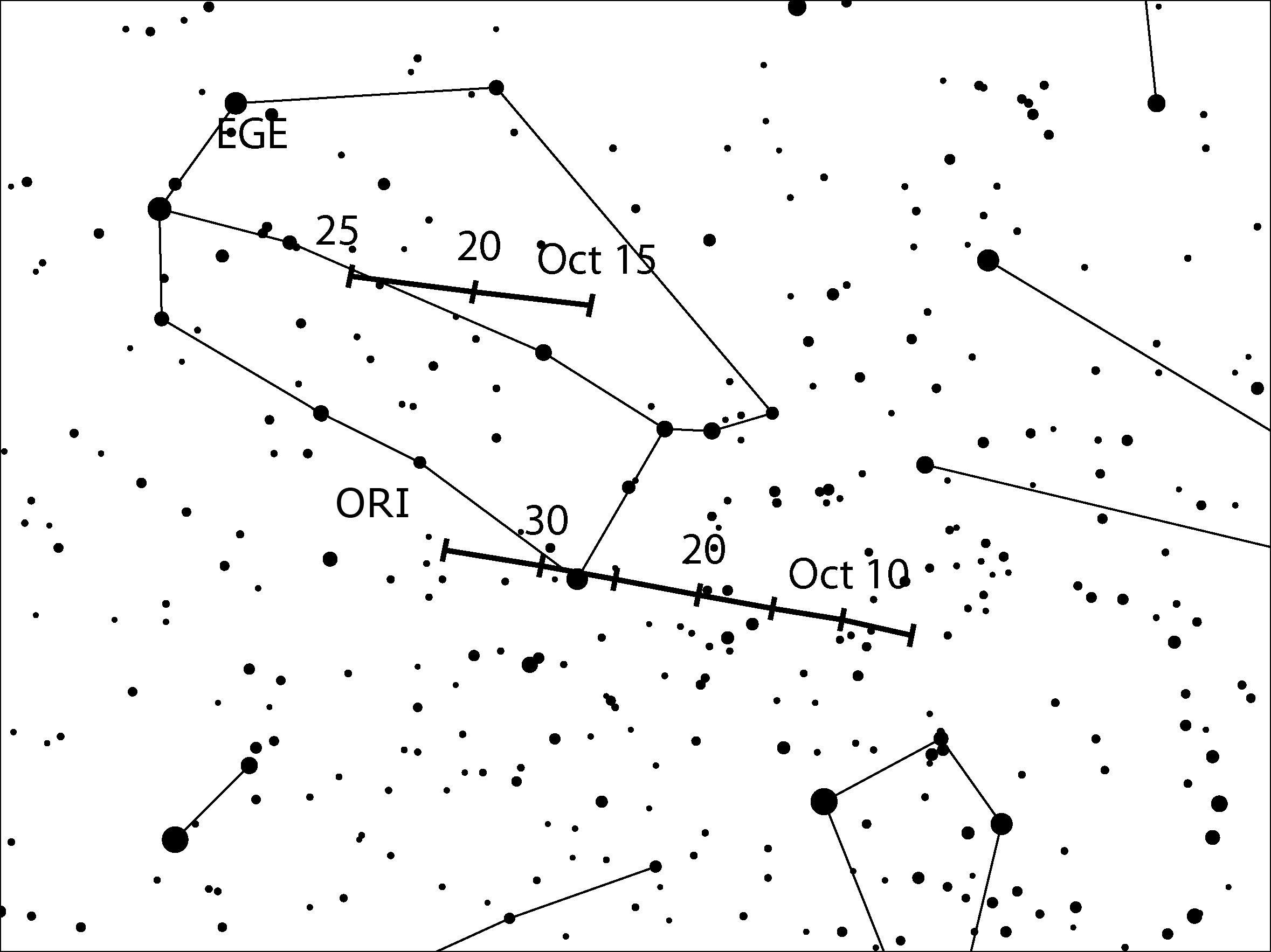
The October Camelopardalids, which can be observed at the beginning of the month between 5 and 6 October, reach rates of up to 5 meteors per hour. Their circumpolar radiant reaches its maximum this year on 6 October (alpha 164°, delta +79°) under optimal conditions (new moon on 10 October). Slightly increased activity was recorded in 2016 and 2018. Data on this shower have been documented since 2005.
In addition, the Draconids begin their short period of activity on 6 October. No increased activity is expected at the maximum, which occurs one day before new moon on 9 October. Under these optimal conditions the hourly rates of these very slow shower meteors are usually around 5 meteors per hour.
The Orionids start their activity at the beginning of the month on 2 October and remain active beyond the end of the month. At the maximum on 21 October the hourly ZHR is in the range of 20 to 30 meteors per hour. The waxing moon leaves the second half of the night undisturbed until shortly after the maximum.
The activity of the Epsilon Geminids coincides with that of the Orionids. Because of the similar geocentric velocity, the paths of the meteors of both showers should be plotted on charts, especially in visual observation, to ensure a reliable shower assignment. The maximum on 18 October with 3 meteors per hour is not very pronounced. The first quarter moon leaves the second half of the night free for observations.
The Leonis Minorids begin their activity in the middle of the month. The maximum is reached on 24 October. Data from previous years give a maximum possible ZHR of 5 meteors per hour around the date of the maximum or shortly before. However, the full moon makes it very difficult to follow this low activity.
In the area of the ecliptic the southern part of the Taurid complex remains active with ZHRs of about 2 to 5 meteors per hour. The northern part begins its activity in the middle of the month with similar ZHRs of around 5 meteors per hour.
September 2026
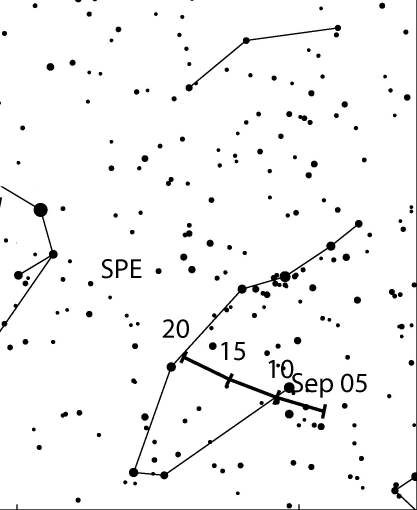
The Aurigids have been active since the end of August. The maximum is reached in the night from 31 August to 1 September and is severely affected by the full moon. Under optimal conditions the ZHRs would be in the range of ten meteors per hour.
After the Aurigids, the September Epsilon Perseids become active from 5 September. The maximum ZHR is reached this year on 9 September at around 20:00 local time. Bright meteors are observed more frequently during the period of activity. This year the maximum can be followed without restrictions (new moon on 11 September). The rates are in the range of 8 meteors per hour, and the radiant is already high enough above the horizon in the first half of the night from about 23:00 local time.
On 20 September the southern part of the ecliptic Taurid complex starts. Over the rest of the month and into December it becomes the dominant component of the ecliptic complex. Mainly slow shower meteors with ZHRs of five meteors per hour can be observed. The activity of the antihelion source pauses temporarily from 20 September.
The September Lyncids have been added to the meteor shower list as a possible new shower. From about mid September into October there is noticeable activity from the constellation Lynx. On 25 September 2023 an increased rate was recorded shortly after midnight that can be assigned to this shower. At least two sources of activity can therefore be named, which can be combined under one designation (September Lyncids) in visual observations. The start is set to the date of the maximum of the September Epsilon Perseids (9 September). Activity can be expected until mid October. Further observations from this period are therefore welcome to refine some parameters of the shower.
The Daytime Sextantids can be followed from the beginning of September to the beginning of October. The possible maximum occurs on 1 October. Under optimal conditions individual Sextantids could be observed shortly before morning twilight. This year observations are severely affected by the waning moon around the maximum. Short observing intervals should be chosen to follow the rapidly changing conditions in the morning sky. The time of the maximum and other data on this shower are still uncertain.
August 2026

At the end of the previous month the conditions for observations were still very limited (full moon on 29 July). They improve towards the middle of the month, so that the maximum of the Perseids can be observed without restrictions.
This year the Perseids reach their maximum on 13 August between 04:00 and 05:00 local time. This corresponds to a solar longitude between 139.8° and 140.3°. The mean maximum in 2026 is therefore between 12 August 23:00 and 13 August 11:00 local time. At the beginning of the night the radiant in the constellation Perseus is already about 30 degrees above the horizon. The new moon on 12 August offers optimal observing conditions. Model calculations suggest that the maxima will be noticeably below the familiar ZHR of 100. In previous years individual secondary maxima occurred one to two days after the main maximum. From 2022 to 2024, however, no activity occurred at a similar interval. Nevertheless, the nights before and after the maximum should also be included in the planning of observations.
With the Kappa Cygnids another meteor shower reaches its maximum on 17 August. The radiant is above the horizon all night. At the maximum the rates are about three meteors per hour, which can be observed without restrictions, preferably in the second half of the night. The available video data show a clear maximum at a solar longitude of 144 degrees (corresponding to 16 August) and clearly recognizable activity from 2 August to the beginning of September. Increased rates were recorded in 2007, 2014 and 2021. Strikingly slow shooting stars can be observed, and brighter events may also occur.
The Eta Eridanids begin their activity on 31 July and can be observed until 19 August. The maximum is reached on 7 August. The conditions improve until the maximum (new moon on 12 August). Meteors of this shower are best observed in the second half of the night.
July 2026
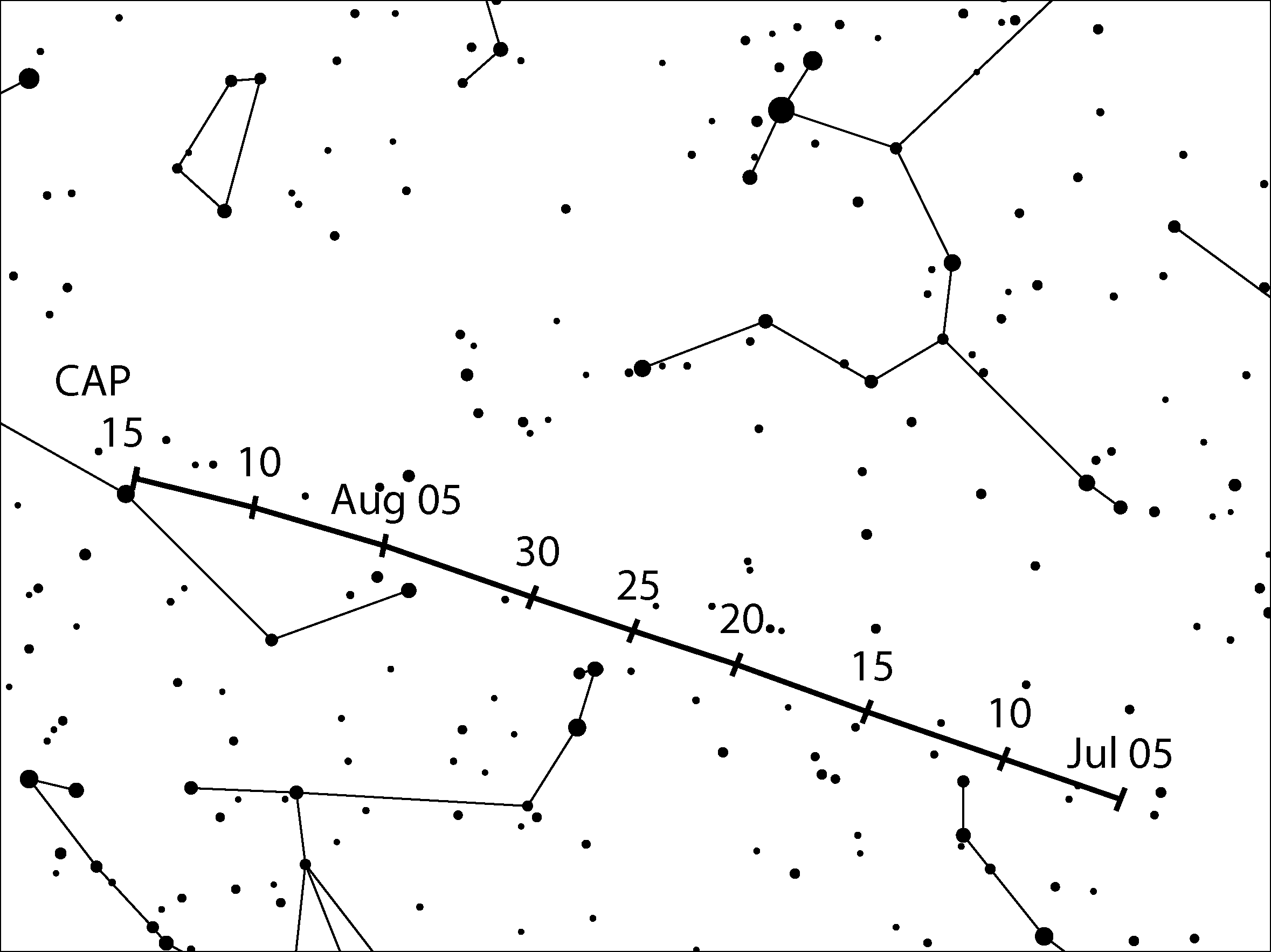
In July the nights are getting longer again, which offers more opportunities to observe some meteor showers. Possible observations should be planned for the first half of the month until about 15 July.
The Alpha Capricornids are the first meteor shower of the month and start their activity on 3 July. This shower can be observed beyond the end of the month and reaches its maximum on 31 July. Its slow meteors differ clearly from other showers in this period, and brighter events can also occur. The conditions for observations improve until the middle of the month (new moon on 14 July).
The July Pegasids can be observed from 4 to 14 July. The maximum occurs on 10 July. The radiant is then at a right ascension of 347 degrees and a declination of +11 degrees. Unfortunately observations are affected by moonlight (last quarter on 7 July). For observers at middle northern latitudes the radiant is above the horizon all night. Under favorable conditions the rates reach at most five meteors per hour.
The Southern Delta Aquariids have been active since 12 July and reach their maximum on 31 July. The particles of this shower have a much higher geocentric velocity and therefore differ clearly from the Alpha Capricornids. This year observations of the maxima of both showers are only possible with major restrictions because of the full moon on 29 July.
In the last ten days of July the July Gamma Draconids are active from 25 to 31 July. At the maximum the radiant is in the constellation Draco at a right ascension of 280 degrees and a declination of +51 degrees. This year this position is reached on 28 July at around 15:00 CEST, and the maximum is severely affected by the full moon. No conspicuous activity was found from 2017 to 2024. The data on the overall activity available so far show that this shower occurs every year and has a short, variable maximum. The meteors have a low geocentric velocity and produce slow shooting stars. Rates of about five meteors per hour are expected.
After the middle of the month the first Perseids can already be observed. Because of the moon phase (full moon on 29 July) the observing conditions for this best known meteor shower deteriorate towards the end of the month and into August. More information follows in the August preview.
June 2026

The summer month begins with low meteor activity. The rates hardly rise above the sporadic background. Because of the short nights only a small time window remains for observations. The first half of the month until the maximum of the June Bootids is particularly suitable.
From the beginning of the month until about 24 June the Daytime Arietids are another interesting meteor shower. The period given in previous years is still uncertain. The shower reaches its maximum on 7 June. When twilight begins, the radiant is only just above the horizon. In addition, the waning moon severely limits the observing opportunities. The archive data of previous years show recognizable activity in this period, but no clear activity profile as known from other meteor showers.
The June Bootids reach their maximum on 22 June at around 03:00 local time and are generally easy to observe. Their radiant is at a declination of about 48 degrees and is therefore circumpolar at our latitudes. Because of twilight, however, the usable observing period is shortened. The waxing moon is at first quarter on 21 June and makes observing more difficult. The second half of the night is therefore recommended. Because of the low entry velocity of the particles, strikingly slow shooting stars occur at times. In the past there were repeatedly larger outbursts. Between 1998 and 2004 hourly rates of up to 100 meteors per hour were recorded at times. Increased rates are also documented beyond doubt for 1916, 1921 and 1927. For showers with a short period of activity, observations should therefore be made as continuously as possible during the entire period of visibility, provided the conditions allow it.
May 2026
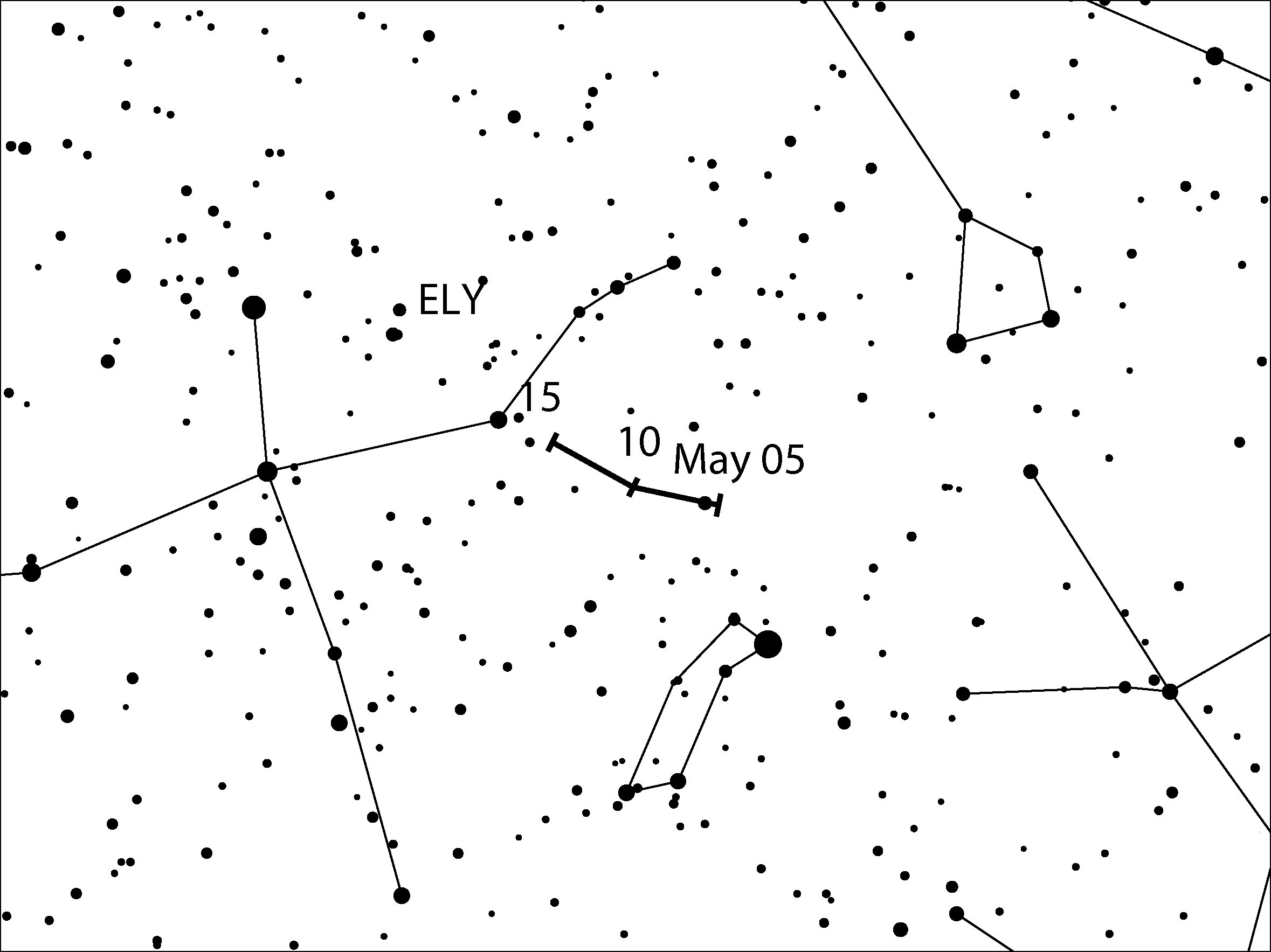
At the beginning of May the Eta Aquariids are already active. The shower reaches its maximum on 6 May, but it can only be observed in the morning hours.
The radiant rises at around 03:00 local time. Even under optimal conditions the time window is limited to only one hour. At the maximum the ZHR is between 40 and 65 meteors per hour. However, this only applies to lower latitudes up to 40 degrees north and under optimal conditions, which this month are severely affected by the bright waning moon in the morning. The visual data since 1984 show an average ZHR of 30 meteors during the period of activity from 3 to 10 May. Outside the maximum a ZHR of half this value can be expected. Under optimal conditions at our latitudes at most four to eight Eta Aquariid meteors can be observed around the maximum.
The Eta Lyrids are active from 5 to 14 May. This year the maximum on 10 May coincides with the last quarter of the moon, so observations are not too severely affected. Because of the small number of shower meteors a careful assignment (plotting) is recommended. The radiant is above the horizon all night. The visual data from 2007 to 2021 gave mean ZHRs of three to four meteors per hour.
The antihelion source remains active with rates between two and four meteors per hour. There are only small variations in activity. The radiant moves into the area of the constellation Scorpius.
April 2026

After a pause of several months, April starts again with rising rates from interesting meteor showers.
The Lyrids reach their maximum on 22 April at around 20:40 local time. Under ideal observing conditions ZHRs of up to 18 meteors per hour are possible. The radiant of the shower is in the constellation Lyra and reaches a sufficient height above the horizon from about 22:30 local time, which increases further during the night. This year the maximum can be observed undisturbed, as the moon only reaches first quarter on 24 April. Model calculations for the parent body of the shower, comet C/1861 G1 (Thatcher), suggest, however, that no increased activity is to be expected this year. Short outbursts with much higher rates are also known. In 1982, for example, ZHR values of up to 90 were recorded for about one hour.
In addition, the antihelion source is still active, but with hourly rates of two to four meteors it hardly stands out from the background. By the end of April its radiant moves into the constellation Libra.
From 19 April meteors of the Eta Aquariids can also be observed. This shower remains active until about mid May. This year, however, observations are severely affected by the moon. Because of the low height of the radiant above the horizon in Central Europe, mainly the more southern latitudes up to about 45 degrees north are suitable for observations, provided the conditions are optimal. In Central Europe only a time window of about one hour before the start of morning twilight remains to record individual shower meteors.
March 2026

Low rates continue in March. Apart from sporadic meteors, mainly shooting stars from the ecliptic complex of the antihelion source can be observed. The conditions for possible observations improve with the waning moon until the middle of the month.
At the beginning of the month the radiant is below the constellation Leo. By the end of the month this area moves into the constellation Virgo. The low entry velocity produces slow meteors with low rates of up to 3 meteors per hour.
In general, the number of visible meteors increases during the night until the morning hours. Visual observations should preferably be made with a chart, because plotting allows the few meteors within an hour to be assigned to a shower more reliably.
February 2026

In January the Quadrantids brought the first high rates of the new year. In February the low rates of mainly sporadic shooting stars follow again. Most individual shower meteors come from the complex of the antihelion source, with only two to three meteors per hour. This year the second half of the month is suitable for observing this low activity.
At the beginning of the month the Coma Berenicids can still be observed. Although the drift table only gives data until 30 January, some meteors can still be detected in the first days of February, as in previous years. The rates are in the range of three meteors per hour.
The rest of the month is dominated by the antihelion source. In this ecliptic complex several weak meteor showers of low activity overlap. Even in video data it is not possible to distinguish different radiants, so they are combined into one. During the month its radiant moves into the southern part of the constellation Leo.
January 2026
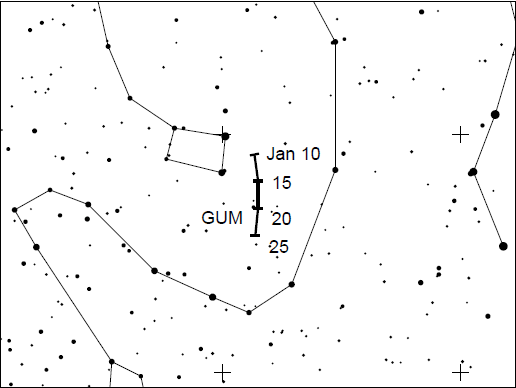
At the start of the new year the Quadrantids are already active at the beginning of the month. They are the first major meteor shower in the sky and reach their maximum on 3 January. However, the full moon affects possible observations, so that only brighter events can be recorded to a very limited extent. Under optimal conditions up to 80 meteors per hour could be observed. The Quadrantids remain active until 12 January.
The Kappa Cancrids, which first showed increased activity around 10 January in 2015, are active again this year. The radiant (alpha 138°, delta 9°) reaches the position of 2015 again on 9 January at around 23:30 CET. The waxing moon makes it difficult to follow the activity reliably. At about 47 kilometers per second the shower meteors are faster than the meteors of the nearby antihelion source, which reach about 30 kilometers per second.
The Gamma Ursae Minorids begin their short period of activity on 10 January. At the maximum around 18 January the rates reach about three meteors per hour. This year undisturbed observing conditions are expected thanks to the new moon on 18 January. Some data on the activity of this meteor shower are still uncertain.
The activity of the ecliptic complex of the antihelion source can still be observed. In January the area moves into the constellation Cancer. The Coma Berenicids, active since December and appearing to come from the constellation Coma Berenices, remain active into February with low rates of around three meteors per hour. Towards the end of the month the observing conditions improve with the waning moon.
December 2025
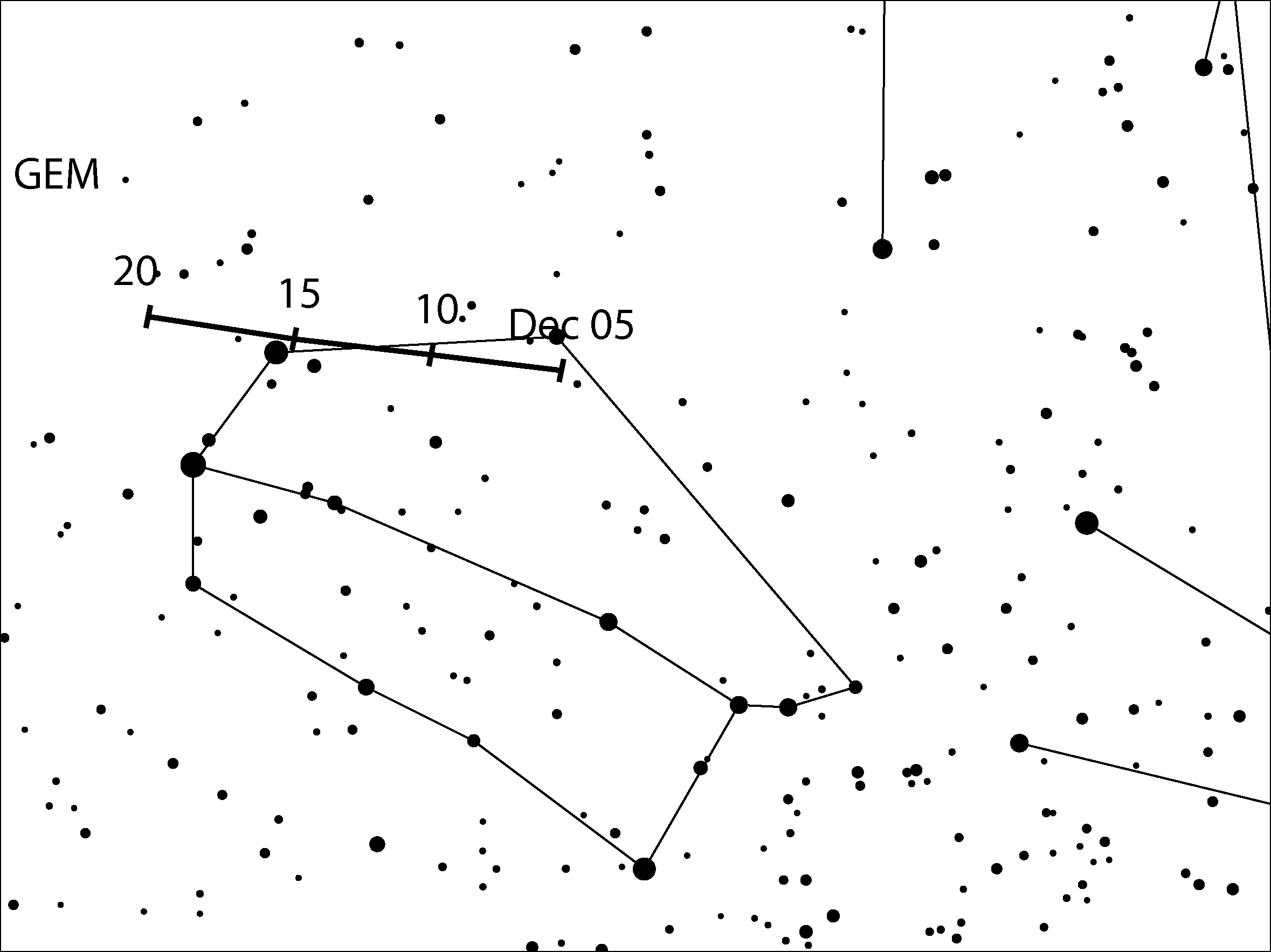
At the start of the winter month the November Orionids are still active until 6 December. Because of the waxing moon (full moon on 5 December) observations in the second half of the night are possible with restrictions.
Observations of the Andromedids at the beginning of the month are only possible to a very limited extent because of the moon phase. At the expected maximum on 1 December the radiant is at the coordinates alpha 23° and delta +50°. The last outburst was observed on 28 November 2021. The available data of previous years indicate that a certain rate can be observed every year.
The shower of the month, the Geminids, reaches its maximum under only slightly affected conditions on 14 December at around 09:00 local time. Hourly ZHRs of up to 150 meteors per hour are possible. The radiant is already above the horizon in the evening sky and culminates at around 02:00 local time. According to calculations, the peak of the maximum this year is between 13 December 16:00 and 14 December 13:00 local time. The broad maximum of the Geminids shows a ZHR of 100 and more for about 10 to 12 hours. Around the maximum short observing intervals (at most 15 minutes) should be chosen.
Only few data are still available on the December Monocerotids. Their period of activity extends until 20 December. The maximum on 9 December is severely affected by the waning moon in the second half of the night. Under good conditions the hourly rates are in the range of two to three meteors per hour.
The Sigma Hydrids also reach their maximum on 9 December. The rates are in the range of two to three meteors per hour, but five to eight meteors per hour are possible at the maximum. Here too the waning moon makes a reliable detection of the activity difficult.
Shortly before Christmas, on 17 December, the Ursids begin their short activity, which lasts until 26 December. Because of the often unfavorable weather in this period, higher activity may have been missed in previous years. Stronger outbursts of this shower are documented for 1945 and 1986. According to model calculations the maximum is reached on 22 December at around 06:00 local time, with at most 25 meteors per hour. The circumpolar radiant reaches its greatest height in the morning hours.
As a preview of the new year, the first Quadrantids can already be observed at the end of the last ten days of December. The circumpolar radiant is high enough above the horizon mainly in the second half of the night.
November 2025
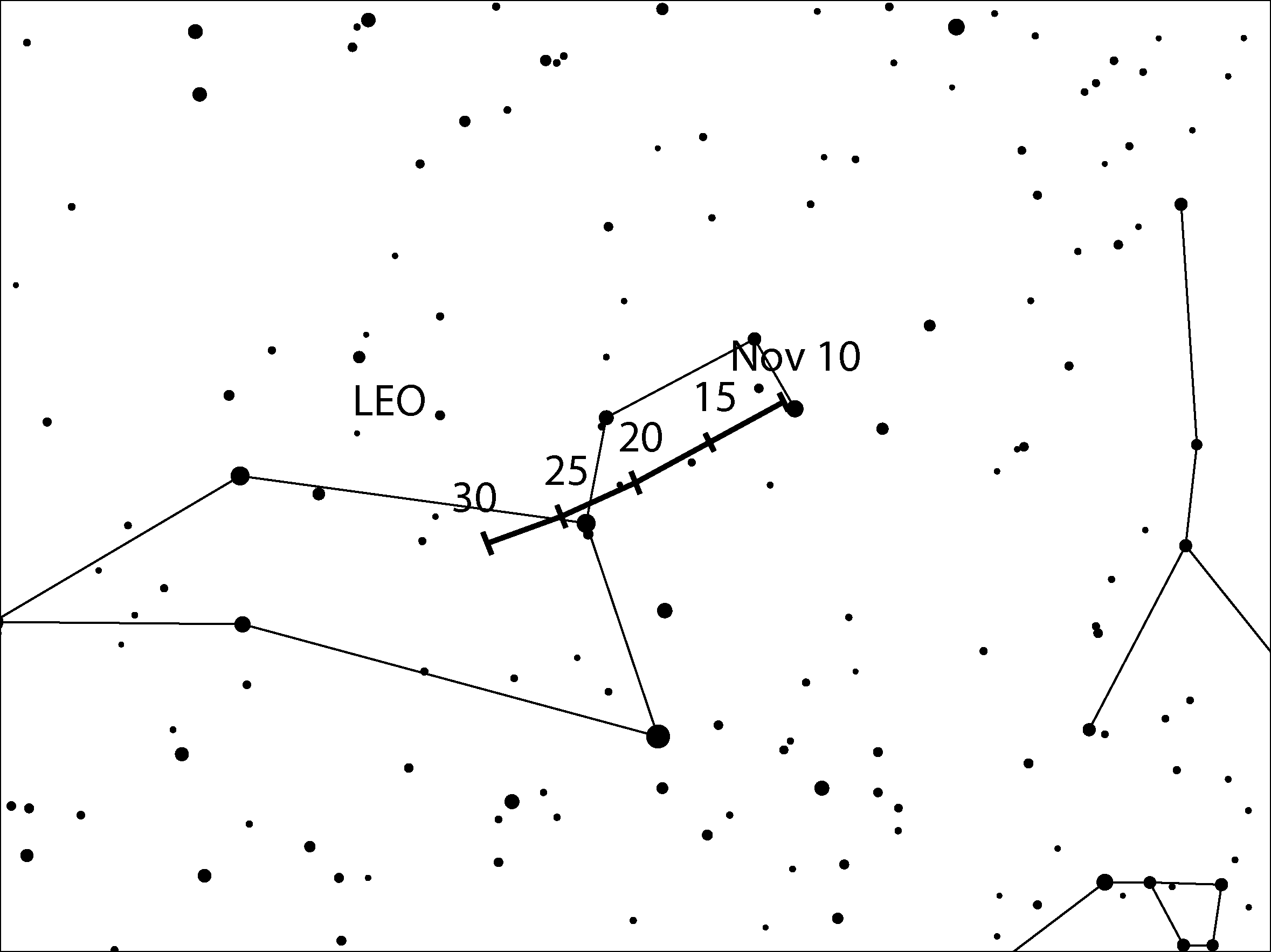
The Taurid complex remains active in the ecliptic. The northern part reaches its maximum on 12 November. In the week around 3 November brighter fireballs could also occur. Most recently, 2022 was one of the so called "swarm years". At that time, however, the higher rates were close to full moon, so that only video observations of this activity are available. The weak maximum of the southern part occurs around 5 November. It remains active until 20 November.
The Leonids begin their period of activity on 6 November, which lasts until 30 November. The regular maximum occurs on 17 November shortly before 19:00 local time and is free of moonlight this year. According to calculations there is a small chance of higher rates on 9 and 15 November. Otherwise the rates are around 15 meteors per hour.
On 14 November the November Orionids start their activity and remain active into December. The maximum is reached on 28 November, when the radiant is about eight degrees north of Alpha Orionis. The rates are in the range of three meteors per hour. In contrast to the Taurid meteors occurring at the same time they have a higher geocentric velocity. At the end of November this shower is the most active source in the sky.
From the middle of the month the Alpha Monocerotids begin their short activity, which lasts until 25 November. Their maximum occurs on 21 November under optimal conditions, as there is new moon on 20 November. The rates reach about 5 meteors per hour. There were outbursts in 1995 and 2019, in which these high rates lasted for about 30 minutes. The radiant is high enough above the horizon from midnight.