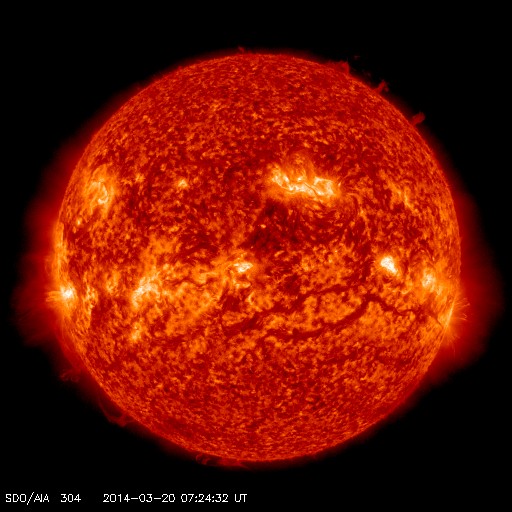
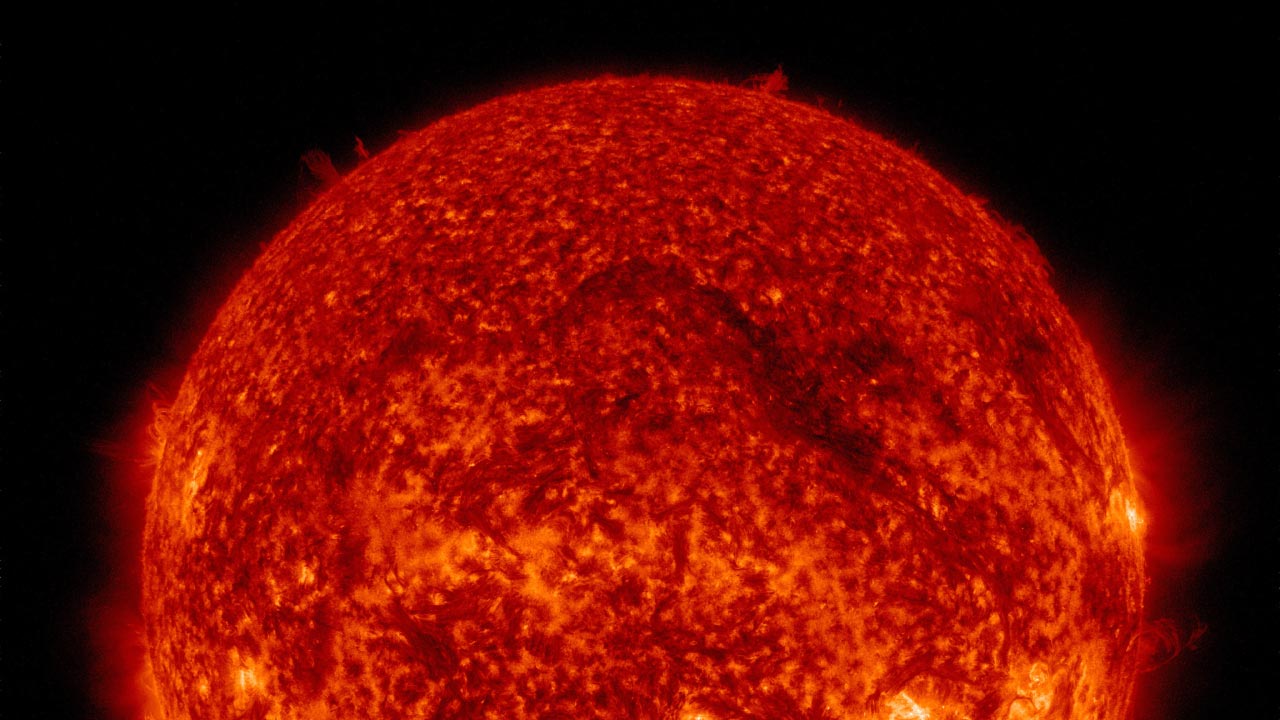
Filaments are clouds of comparatively cool and dense plasma that are held high above the solar surface by magnetic fields. At about 10,000 degrees they are much cooler than the surrounding corona at more than one million degrees. In front of the bright solar disc they therefore appear as dark, elongated threads. At the edge of the Sun the same structures can be seen as bright arches against the dark sky. There they are called prominences.
Filaments are particularly well visible in the light of the hydrogen alpha line and in the 304 Å images of the SDO satellite. They can remain stable for weeks and stretch across a large part of the solar disc.
If the magnetic field that carries a filament becomes unstable, the filament can lift off from the Sun. It rises faster and faster and is hurled into space as a coronal mass ejection. This is called a filament eruption. Part of the material often falls back onto the Sun.
Filament eruptions often happen far away from sunspots. The accompanying flare is therefore often weak and long. Such flares are also called Hyder flares after the astronomer Charles Hyder. Despite the weak flare, the ejected clouds can be large and hit the Earth. They are usually slower than CMEs from sunspots and often need three to four days to reach the Earth. A long filament near the centre of the solar disc should therefore always be watched.