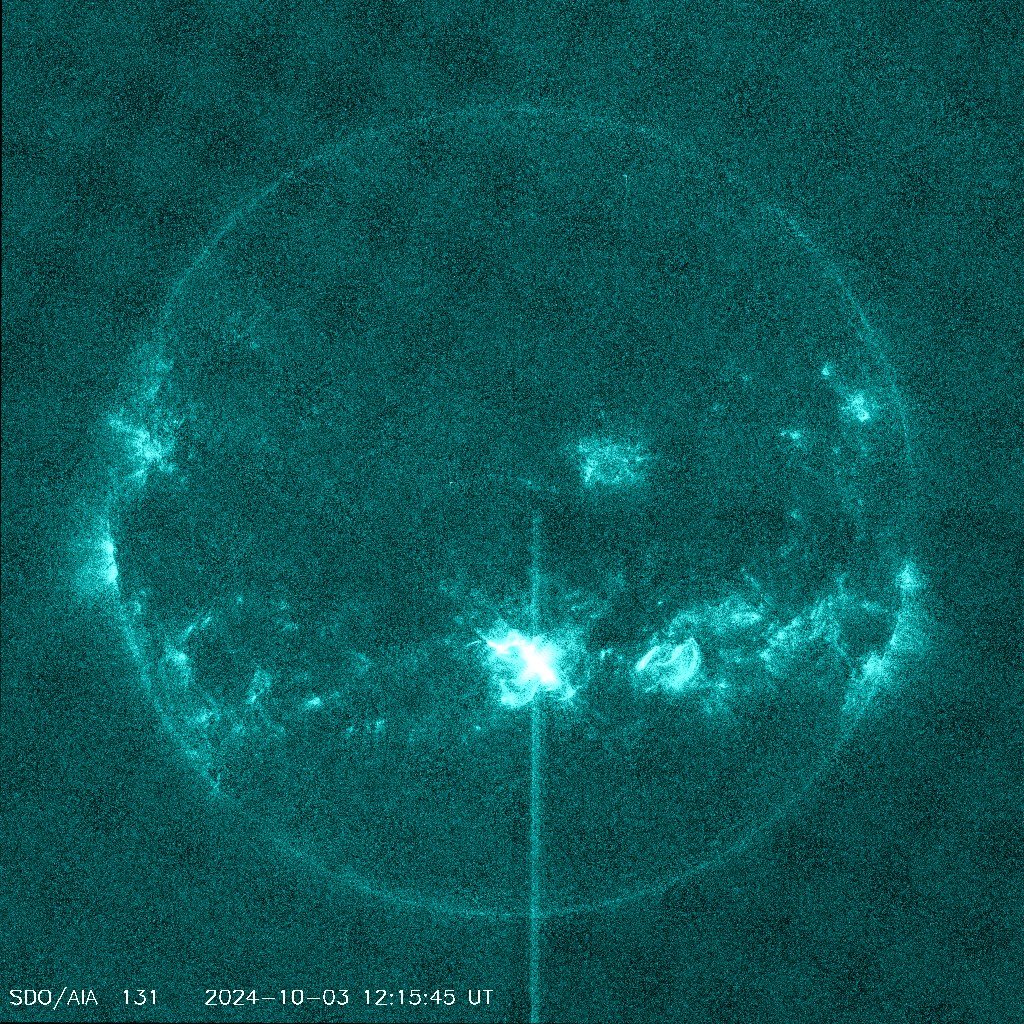
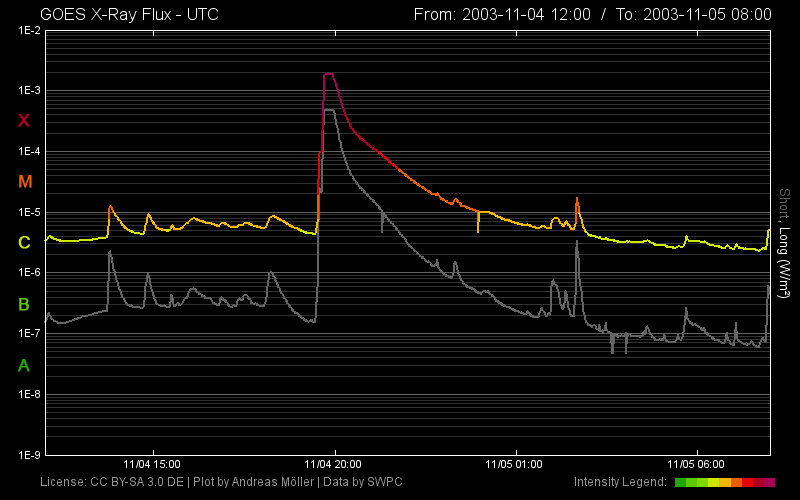
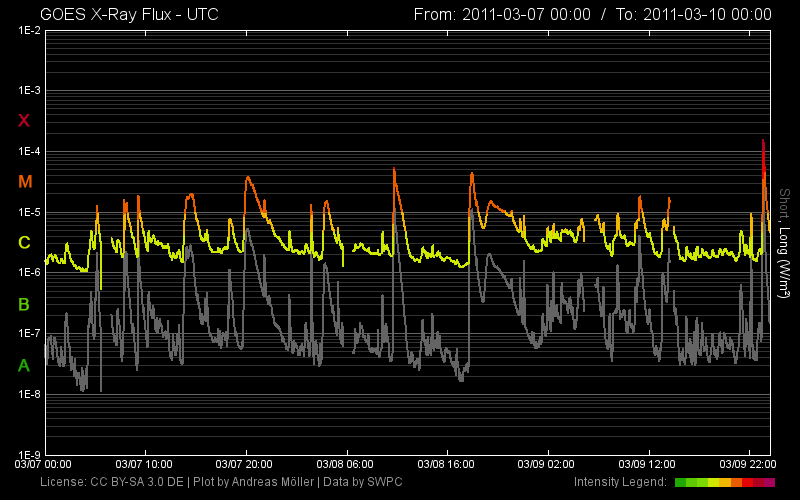
A flare is a sudden burst of radiation on the Sun. It occurs when twisted magnetic fields above an active region rearrange themselves and abruptly release energy. A flare radiates at all wavelengths, especially in X rays. This radiation reaches the Earth after a little more than eight minutes. It can disturb shortwave radio on the day side of the Earth, but it does not cause aurora by itself.
The strength of a flare is measured by the X ray radiation registered by the GOES satellites. The classes are A, B, C, M and X. Each class is ten times stronger than the previous one. The number after the letter refines the classification. A flare of class M5 is therefore five times stronger than a flare of class M1. Class X is open ended. NOAA divides the effects on radio communication into five levels:
Source: NOAA Space Weather Scales
The following two charts show the current X ray flux of the last six hours and the last three days. If the curve is in the green area, the Sun is quiet. If it reaches the yellow or red area, a strong flare has occurred.
Live Plot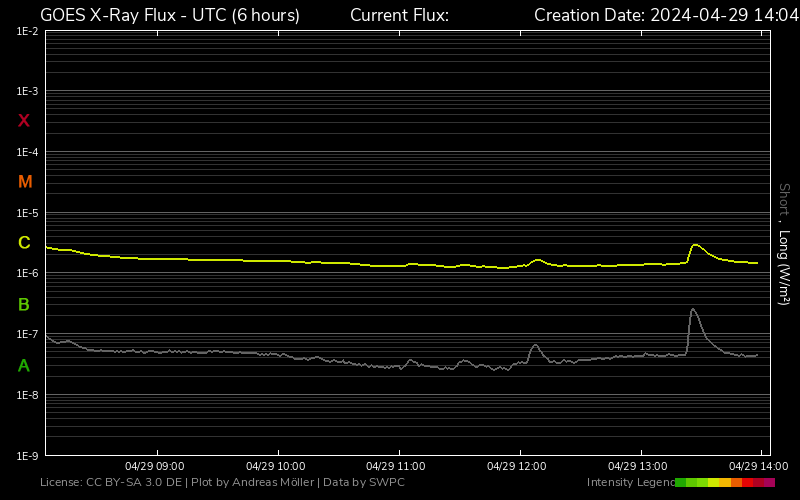
X ray flux of the GOES satellites during the last six hours. (Data: NOAA SWPC, chart: Andreas Möller)
Live Plot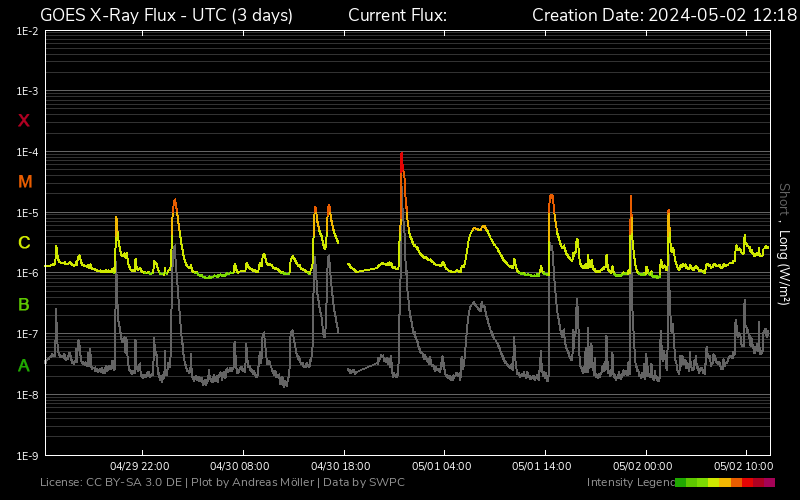
X ray flux of the GOES satellites during the last three days. (Data: NOAA SWPC, chart: Andreas Möller)
Live Plot
Probability of M and X class flares during the next three days. (Data: NOAA SWPC, chart: Andreas Möller)
For the aurora, the flare itself does not matter. What counts is whether it is accompanied by a coronal mass ejection (CME). During a CME, the Sun hurls billions of tonnes of plasma and magnetic field into space. Whether a CME hits the Earth and causes aurora depends on several factors:
- Duration: Long duration events release a lot of energy and are almost always accompanied by a CME. Short, impulsive flares, on the other hand, often occur without a CME.
- Position: The closer an eruption is to the centre of the solar disc, the more likely the CME is aimed at the Earth. Eruptions at the edge of the Sun usually hit the Earth only with a glancing blow or not at all.
- Speed: The faster a CME, the harder it hits the magnetic field of the Earth. Typical CMEs travel at 400 to 1000 kilometres per second. Very fast CMEs reach more than 2000 kilometres per second.
- Class: X class flares are particularly often followed by fast CMEs. But M and C class flares have also caused aurora in Germany.
A CME usually needs one to four days to reach the Earth. The fastest CMEs make it in less than one day. During the Halloween storm in October 2003 it took only about 19 hours.
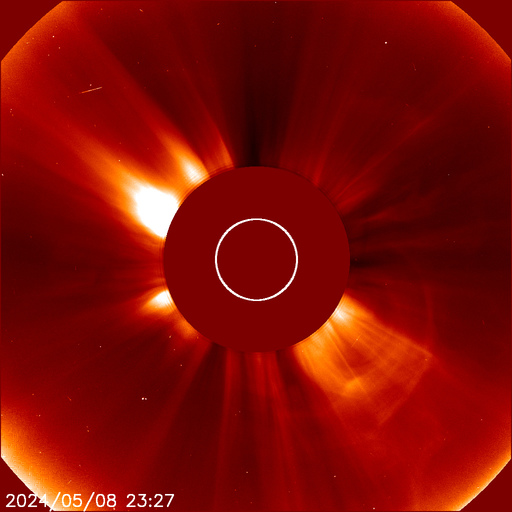
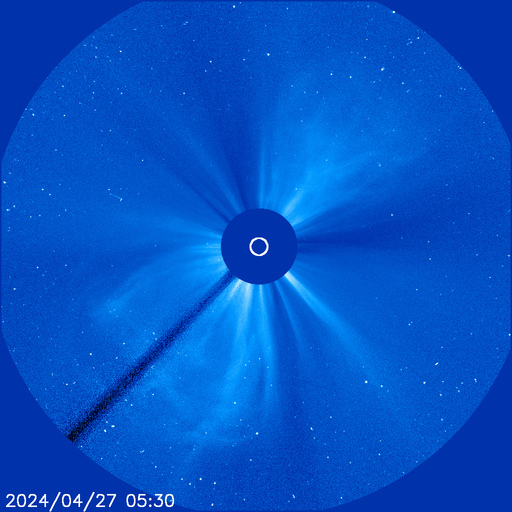
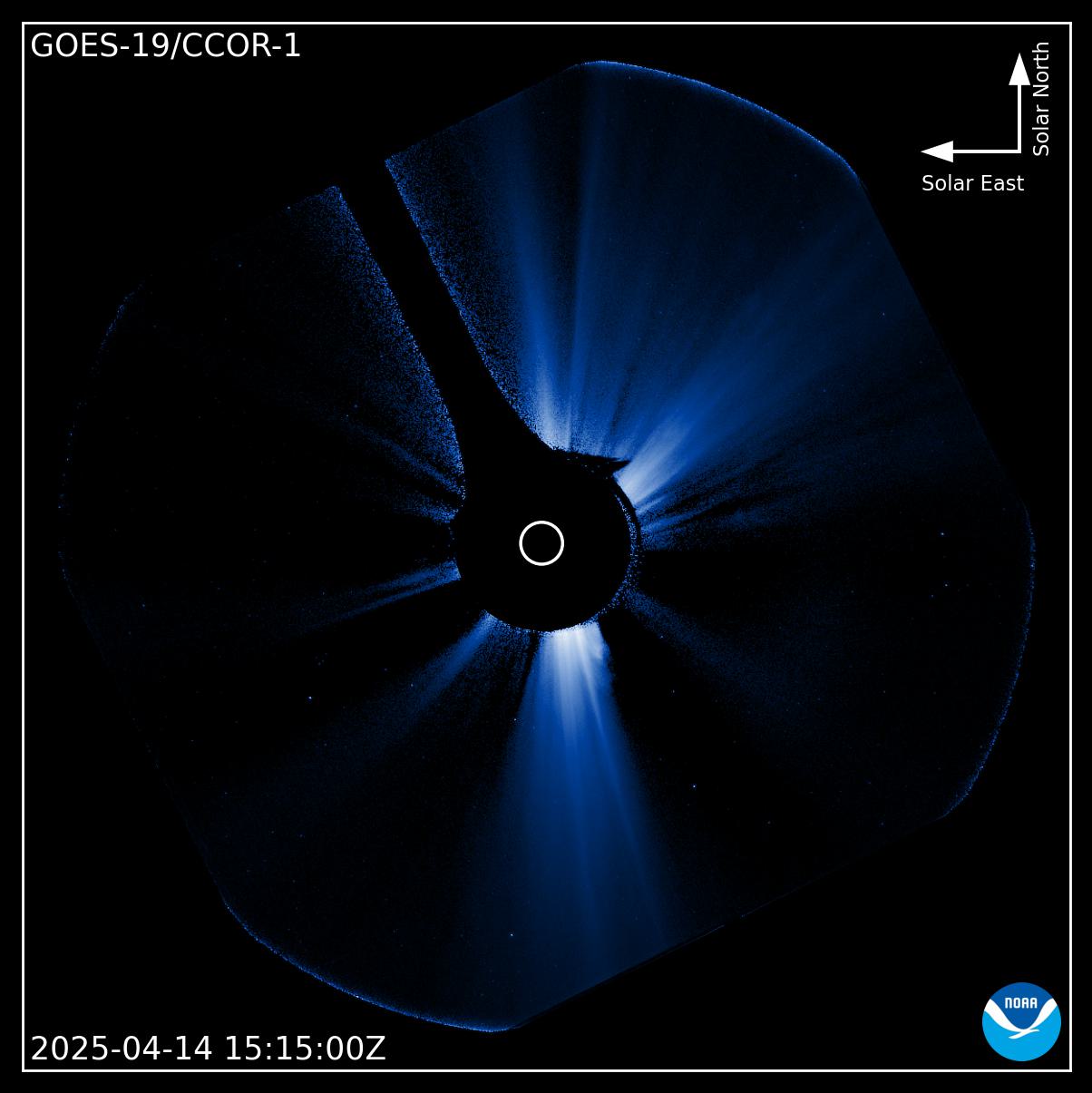
CMEs can be observed with a coronagraph. It covers the bright solar disc with an occulter and thus makes the faint corona visible. Since 1995, the LASCO instrument on board the SOHO spacecraft has been providing such images. Since 2025, the CCOR 1 coronagraph on the weather satellite GOES 19 has also been observing the Sun. Since 2026, CCOR 2 on the SOLAR 1 satellite has joined them.
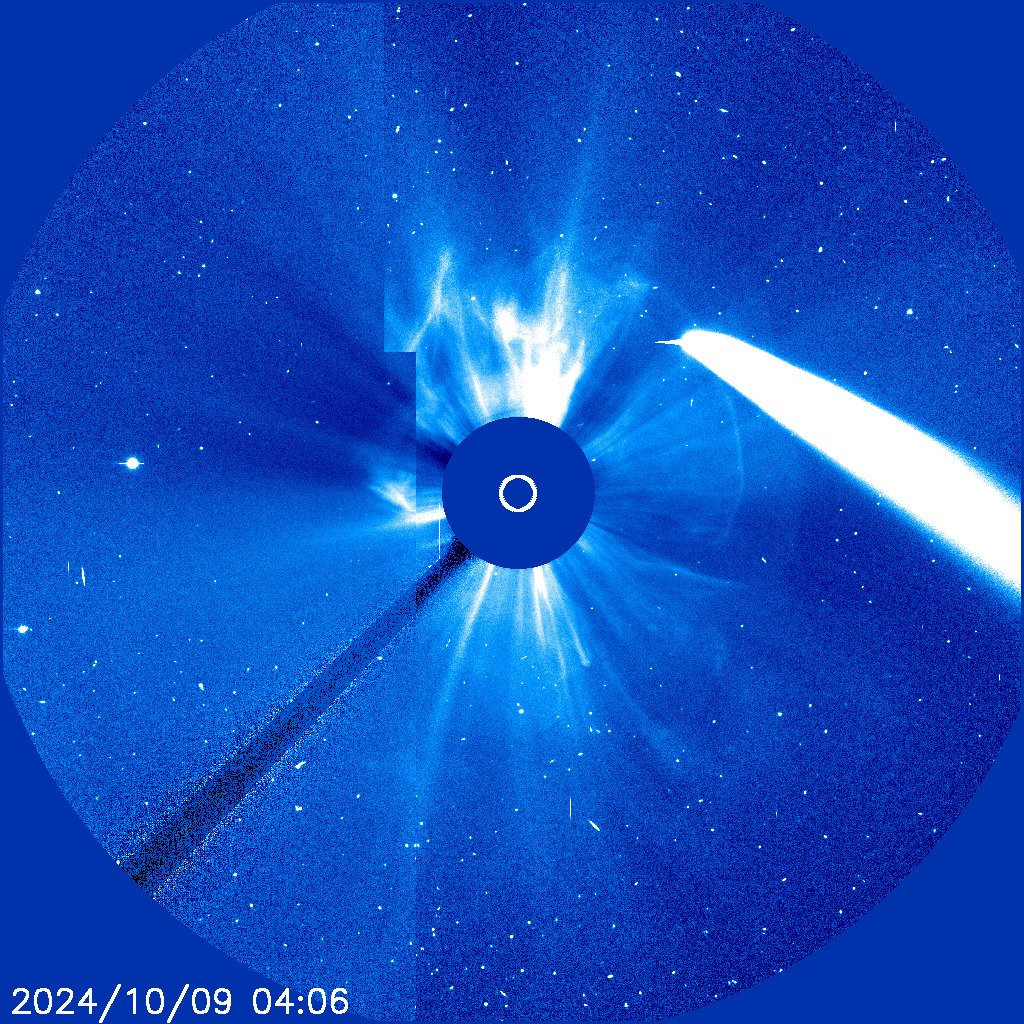
If a CME is aimed at the Earth, it spreads out on the images as a ring around the occulter. This is called a halo CME. However, a halo can also appear when the CME starts on the far side of the Sun and moves away from the Earth. Only images of the solar surface show whether the eruption took place on the front side.
During very strong eruptions, energetic protons hit the image sensor of the camera. The images then show numerous white dots resembling snowfall. Such a proton event is a clear sign of a violent eruption.

Halo CME on 9 October 2024. The following night it caused one of the brightest aurorae of cycle 25. On the right the comet Tsuchinshan ATLAS. (Image: ESA and NASA, SOHO LASCO C3)
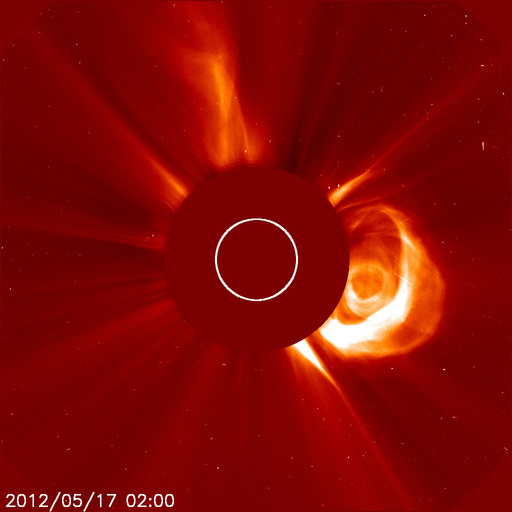
A CME directed sideways on 17 May 2012. It missed the Earth. (Image: ESA and NASA, SOHO LASCO C2)
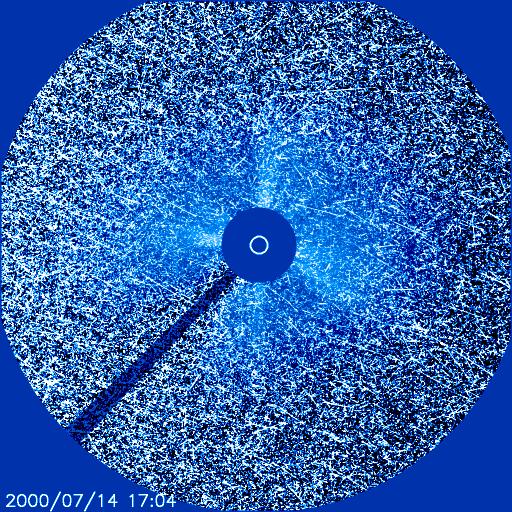
Snow on LASCO C3 caused by a strong proton event on 14 July 2000 (Bastille Day event). (Image: ESA and NASA)