Observer 1: Fernando Molina Sánchez
Date: 29 October 2026
Time: 14:00 to 14:25 CET (UTC+1)
Location: Ajalvir, Community of Madrid, Spain
Solar elevation: 34° to 32°
The halo display in the Madrid region, Spain
Observer 2: Paul Reed
Date: 29 October 2026
Time: 14:40 to 15:10 CET (UTC+1)
Location: Aranjuez, Spain
Solar elevation: 31° to 28°
Observation
On the afternoon of 29 October 2026 at around 14:00 CET, Fernando Molina Sánchez saw the display in Ajalvir, northeast of Madrid. He was out with his dogs and noticed the halos by chance. Until 14:25 CET he photographed them with a smartphone and a DSLR camera.
Above the sun, the upper tangent arc and the Parry arc formed. Both were sharply defined and prominent in the sky. The parhelia were bright and strongly colored, and the parhelic circle extended from them far across the sky. To the left of the sun, a colored section of the infralateral arc appeared at a distance of about 46°. The 22° halo was only faintly visible in places. A circumzenithal arc was absent. It only forms at solar elevations below 32°, and the sun was still slightly higher during the observation.
About 55 km further south, Paul Reed stepped onto his balcony in Aranjuez in the early afternoon of 29 October 2026. He immediately noticed Wegener's anthelic arc, the parhelic circle and a 120° parhelion. After the first photos he went down to the street for a clearer view of the sky. From there the Parry arc and further arcs around the antisolar point were also visible.
Here too, the upper tangent arc and the Parry arc formed above the sun, with the heliac arc above them. Higher up, a vividly colored circumzenithal arc was shining, and the upper 46° contact arc (also called 46° Lowitz arcs) could be seen on it. The parhelia were bright and accompanied by distinct Lowitz arcs. On the parhelic circle, the 120° parhelia and very distinct Liljequist parhelia were visible.
At around 15:10 CET the halos in Aranjuez faded. Only the parhelia remained visible for a while longer.
Observed halo types
The list includes all halo types that could be identified on the photos from Ajalvir and Aranjuez. It is therefore based on the analysis of the photos and not on visual observation alone.
- Both parhelia (EE02/03)
- Upper tangent arc (EE05)
- Circumzenithal arc (EE11)
- Parhelic circle (EE13)
- Lowitz arcs (EE14/15)
- 120° parhelia (EE18/19)
- Supralateral arc (EE21)
- Infralateral arc (EE22)
- Parry arc (EE27)
- Liljequist parhelia (EE28)
- Upper 46° contact arc (EE52)
- Wegener's anthelic arc (EE56)
- Tricker's anthelic arc (EE57)
- Hastings' anthelic arc (EE58)
- Tape arc (EE60)
- Heliac arc (EE61)
- Subhelic arc (EE62)
- Subanthelic arc (EE63)
A 22° halo (EE01) is barely visible on the photos from Aranjuez and only faintly in places on those from Ajalvir.
Observation sites
Ajalvir, observer Fernando Molina Sánchez
View larger map
Aranjuez, observer Paul Reed
View larger map


around 15:06 CET Solar side with Parry arc, upper tangent arc, circumzenithal arc, supralateral arc and several anthelic arcs. Hover over the image with the mouse or tap it to show the labels (in German). (Photo: Paul Reed)


around 14:47 CET Antisolar side with parhelic circle, 120° parhelion, Liljequist parhelia and several anthelic arcs. Hover over the image with the mouse or tap it to show the labels (in German). (Photo: Paul Reed)
Weather situation
On 29 October 2026 a strong high pressure area with a surface pressure of 1020 to 1030 hPa lay over the Iberian Peninsula. At upper levels a ridge extended from Spain to the Bay of Biscay, with a deep trough over the Atlantic to the west. Aranjuez and Ajalvir were located on the southeastern flank of the upper ridge in a northeasterly upper flow. It brought in moist air in which cirrus clouds formed.
At the ground it was sunny and mild. The Madrid Barajas weather station, about 10 km from Ajalvir, reported 2 to 5 oktas of cloud cover in the early afternoon, consisting only of cirrus and cirrostratus. Low and medium level clouds were absent. The temperature was 21 to 23 °C with light winds.
No radiosonde ascent from Madrid is available for this day. According to the weather models, the air between about 8 and 12 km altitude was nearly saturated with respect to ice, at temperatures of −32 °C to −59 °C. The halo producing cirrus clouds were probably located in this layer. From 30 October 2026 the weather pattern changed. Moist air from the Mediterranean brought clouds and rain.
Assessment
Almost all of the halo types seen in Spain are caused by oriented ice crystals. Horizontally floating plates produce parhelia, the circumzenithal arc, 120° parhelia and Liljequist parhelia. If the plates additionally oscillate or rotate about a horizontal axis, Lowitz arcs and 46° contact arcs form. Horizontally lying columns (single orientation) produce the upper tangent arc as well as the supralateral and infralateral arcs. Columns with horizontal upper and lower side faces (double orientation) produce the Parry arc.
The sharpness of the display is striking. The halos were clearly defined and hardly blurred, and the sight in the sky came very close to a simulation. This points to crystals with a very regular shape and precise orientation. Only under such conditions do faint forms such as the upper 46° contact arc become visible. It is one of the rarest halo types and can be seen here on the circumzenithal arc in a wealth of detail that has not been documented photographically before. The heliac arc and even the subhelic arc were also captured on camera.
Also remarkable in this display are the Liljequist parhelia, which fade towards the antisolar point with a bluish tint, just as in a textbook. At the antisolar point, Tricker's anthelic arc formed an inverted V below the parhelic circle. Wegener's anthelic arc was spectrally colored, blue on the inside and red on the outside. The photo towards the zenith clearly shows how Wegener's and Hastings' anthelic arcs separate from each other. The subanthelic arc was also faintly visible. It crossed the parhelic circle between the Liljequist parhelion and the 120° parhelion. Randomly oriented crystals, in contrast, played hardly any role, as the almost absent 22° halo shows.
The spatial and temporal extent of the display is also exceptional. Ajalvir and Aranjuez are about 55 km apart, and the observations cover the period from 14:00 to 15:10 CET. The cirrus clouds with their uniformly oriented crystals therefore covered a large area over central Spain and persisted for more than an hour. A comparison of both sites also shows how the display changed as the sun descended. In Ajalvir the sun was still too high for the circumzenithal arc, while in Aranjuez it shone in vivid colors half an hour later.
Halo displays of this extent usually form in ice fog, where the crystals float just above the ground. In cirrus clouds, such complex displays are extremely rare and hardly documented. The display of Aranjuez and Ajalvir therefore ranks among the exceptional halo observations.
Photos from Ajalvir
The photos were taken with a Google Pixel 7a smartphone and a Canon EOS 7D Mark II with an 18 to 250 mm zoom lens. The clock of the Canon was one hour fast. The times of these photos have been corrected accordingly and are therefore approximate. All photos: Fernando Molina Sánchez.
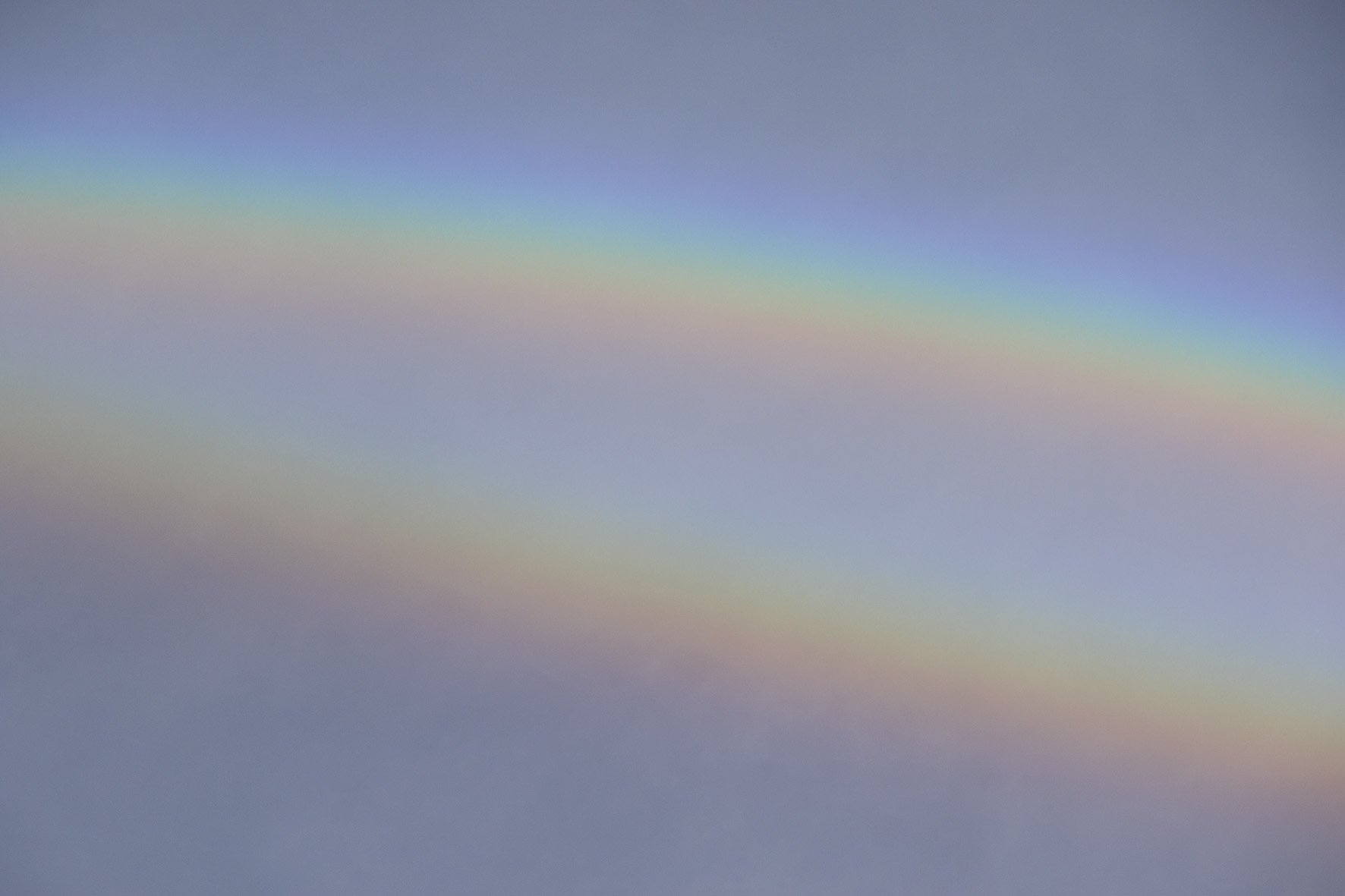
around 13:59 CET Detail view of the Parry arc and upper tangent arc (Photo: Fernando Molina Sánchez)
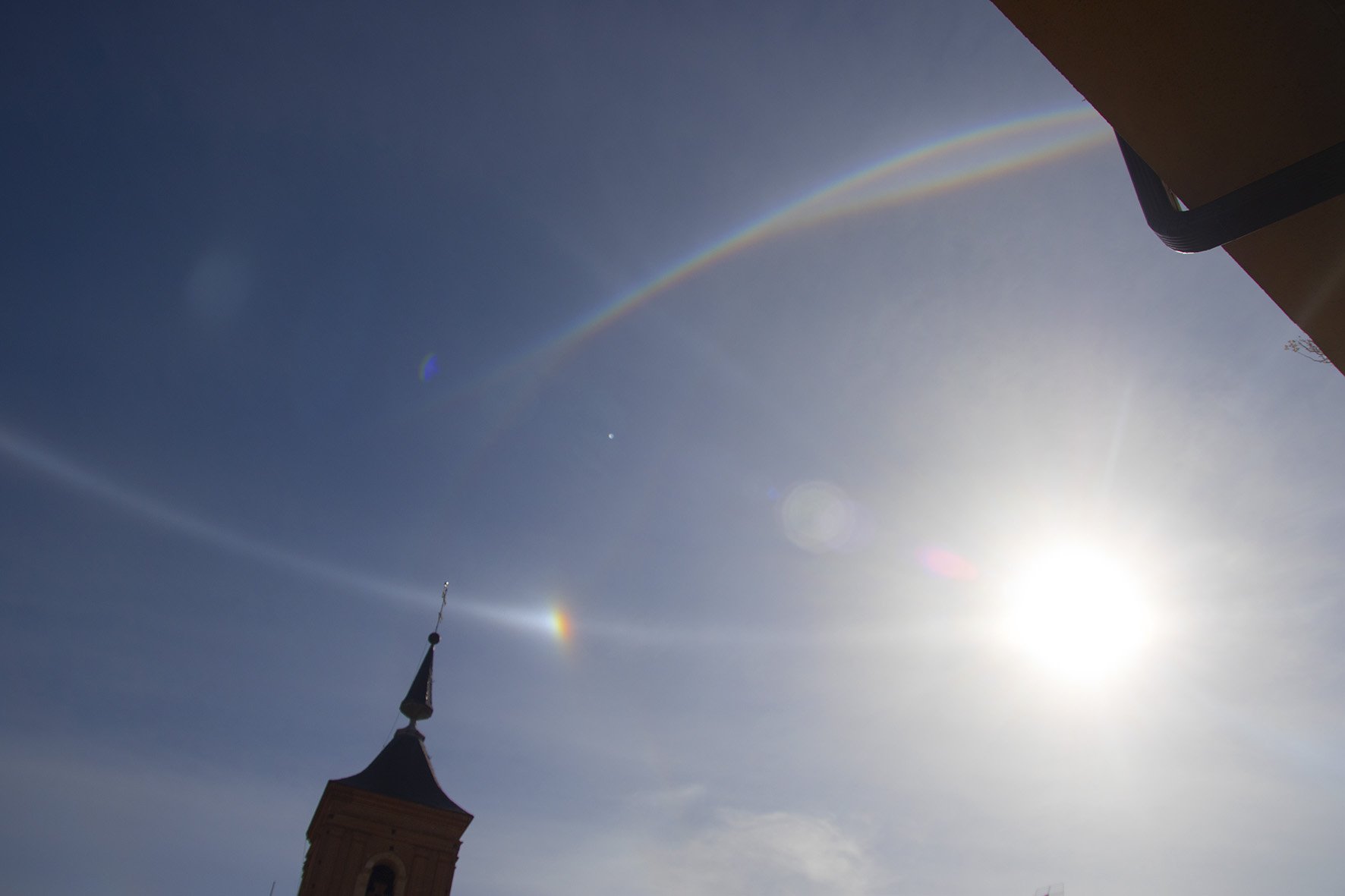
around 13:59 CET Parhelic circle, also between parhelion and sun, with Parry arc, upper tangent arc and the Lowitz arcs at the left parhelion above the church tower of Ajalvir (Photo: Fernando Molina Sánchez)
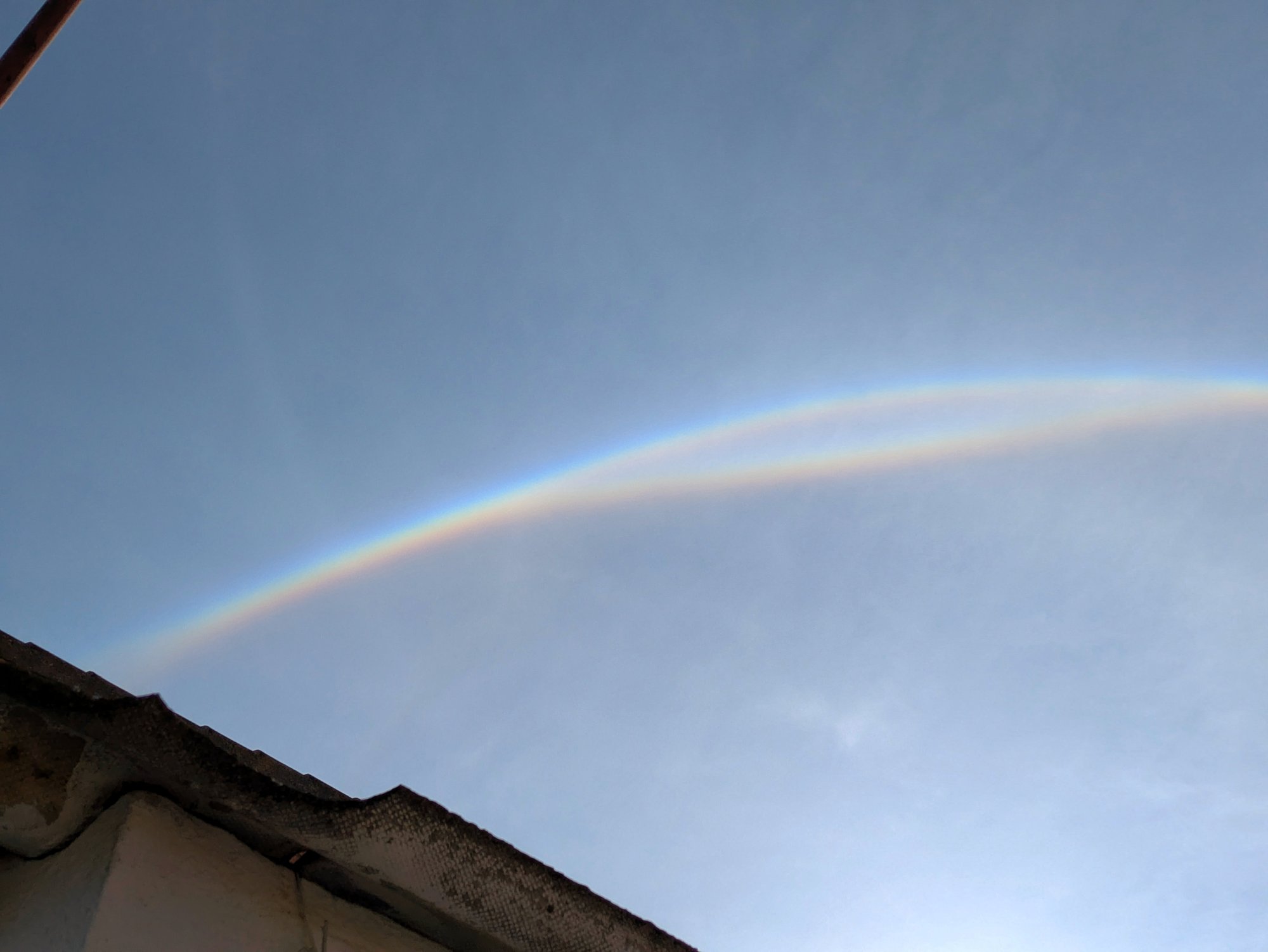
14:02 CET Heliac arc above the rooftops of Ajalvir (Photo: Fernando Molina Sánchez)
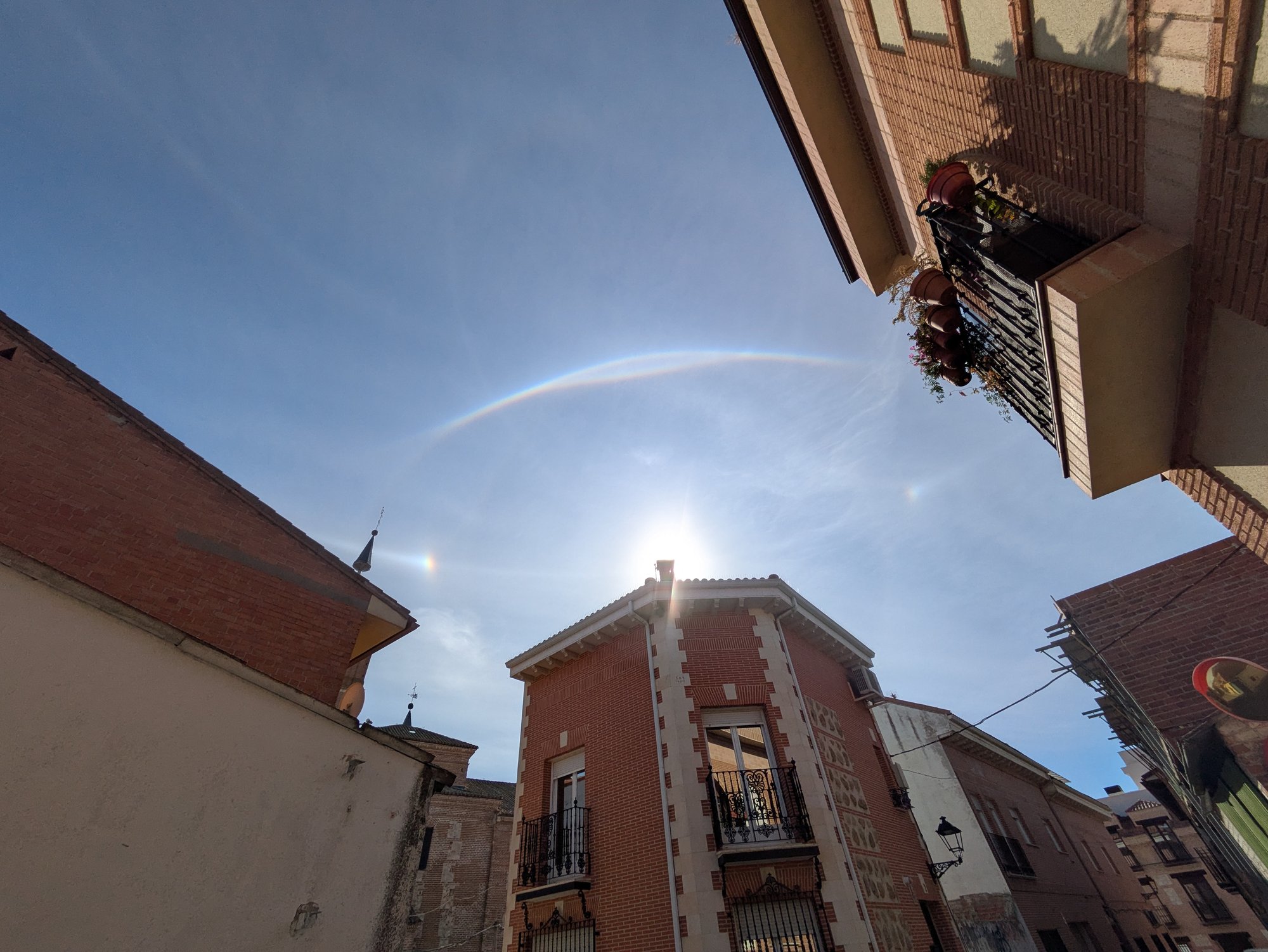
14:02 CET Upper tangent arc, Parry arc and both parhelia with heliac arc and Wegener's anthelic arc (Photo: Fernando Molina Sánchez)
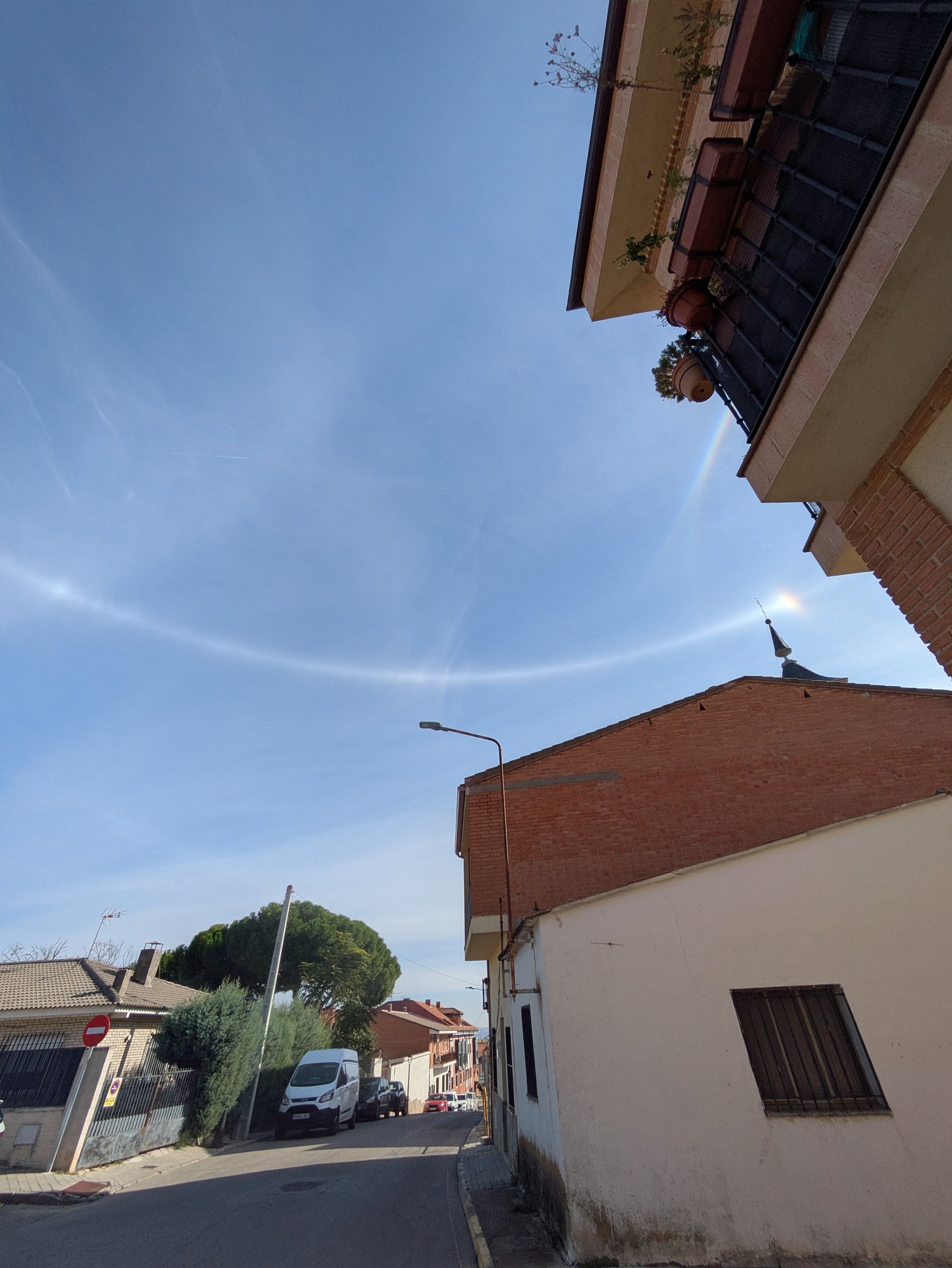
14:07 CET Parhelic circle with parhelion and the subhelic arc at the top left above the tree (Photo: Fernando Molina Sánchez)
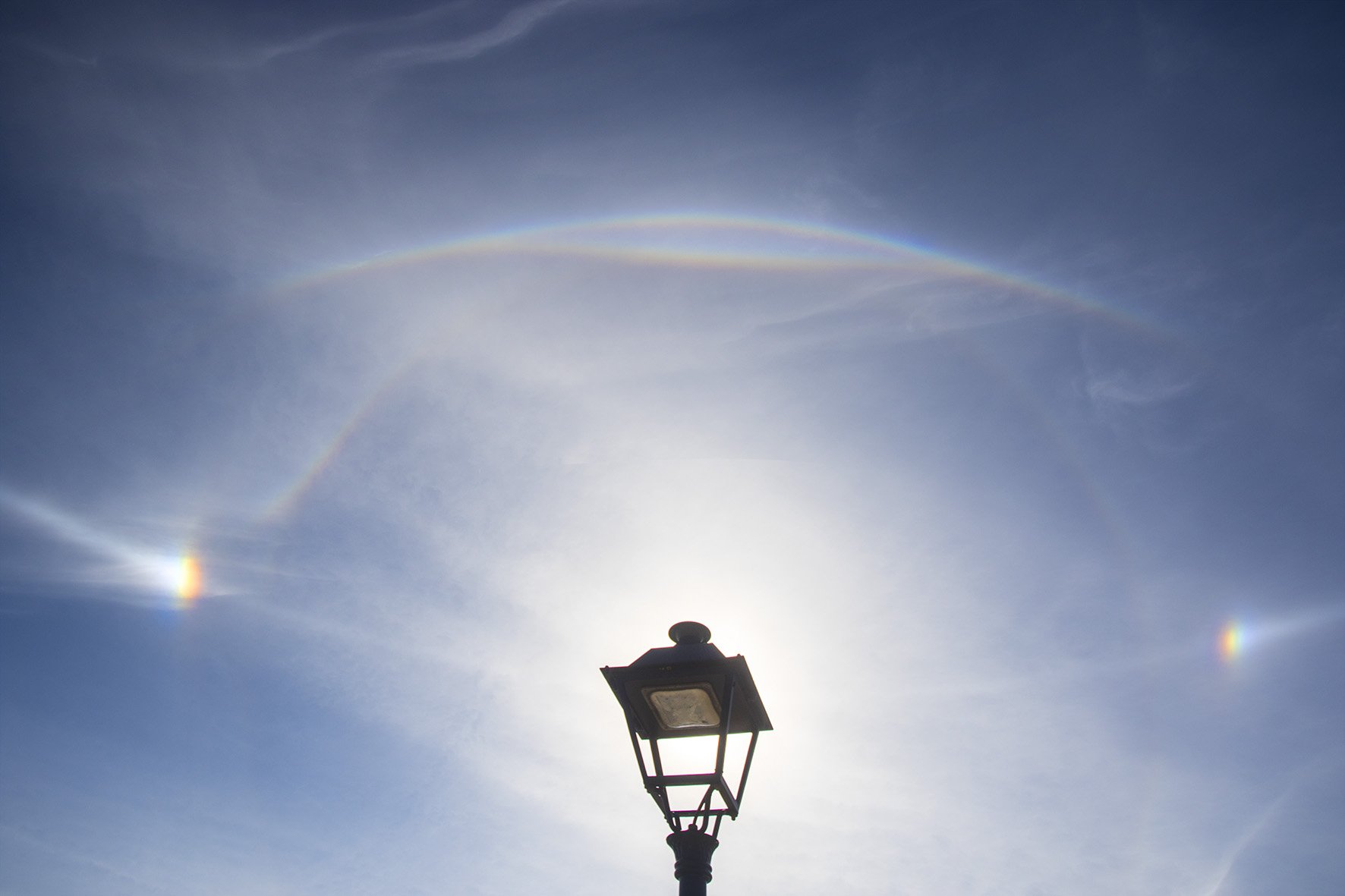
around 14:10 CET Upper tangent arc, Parry arc and both parhelia, on the left the strikingly bright upper Lowitz arc (Photo: Fernando Molina Sánchez)

14:10 CET Parhelic circle with parhelion, below it the subhelic arc (Photo: Fernando Molina Sánchez)
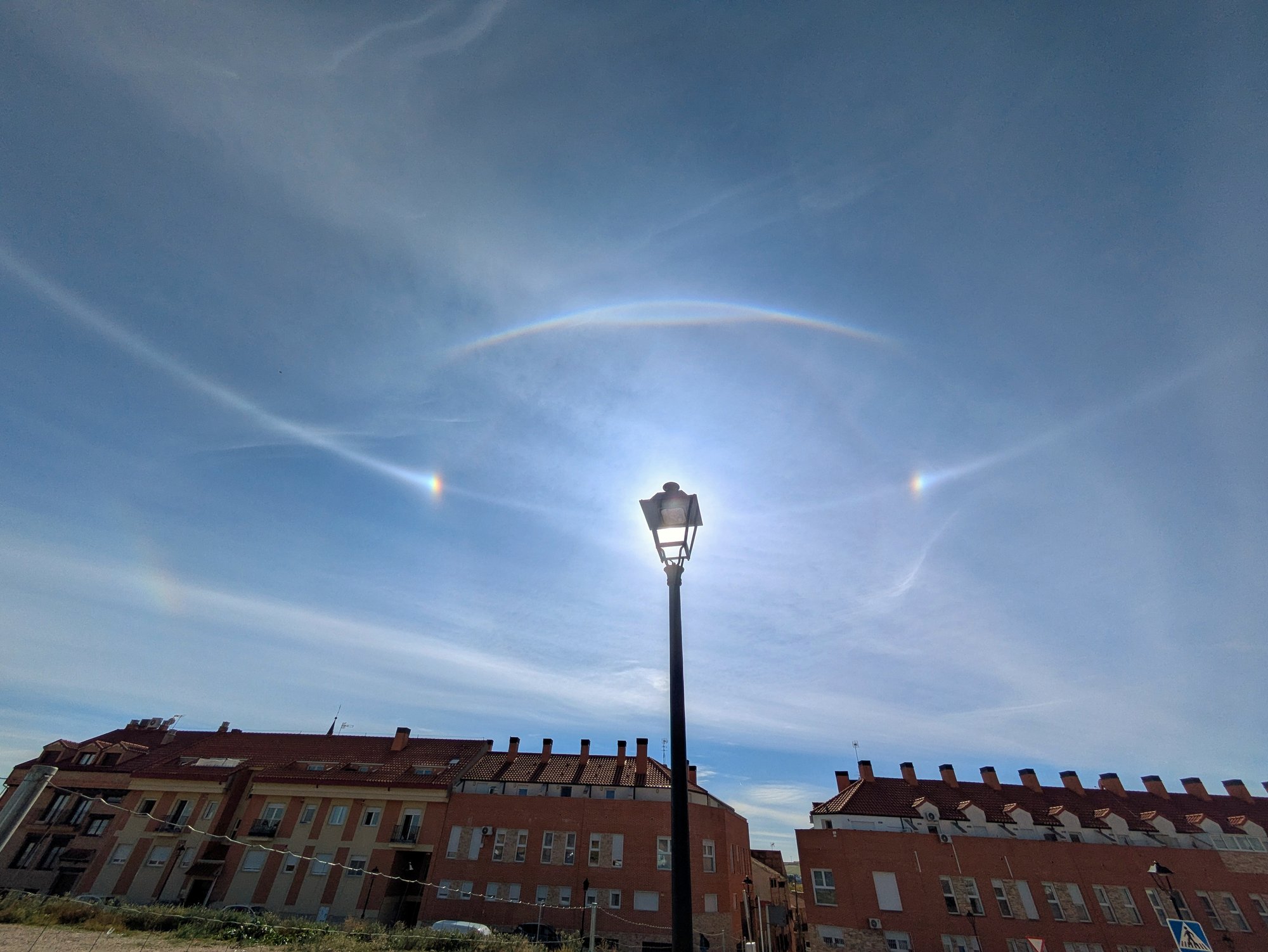
14:13 CET Parhelia, upper tangent arc, Parry arc and the infralateral arc at the bottom left (Photo: Fernando Molina Sánchez)
Photos from Aranjuez
The photos were taken with a Canon EOS 550D with a Samyang fisheye lens and with a Redmi 9 smartphone. The times of the photos taken with the Canon are approximate. All photos: Paul Reed.
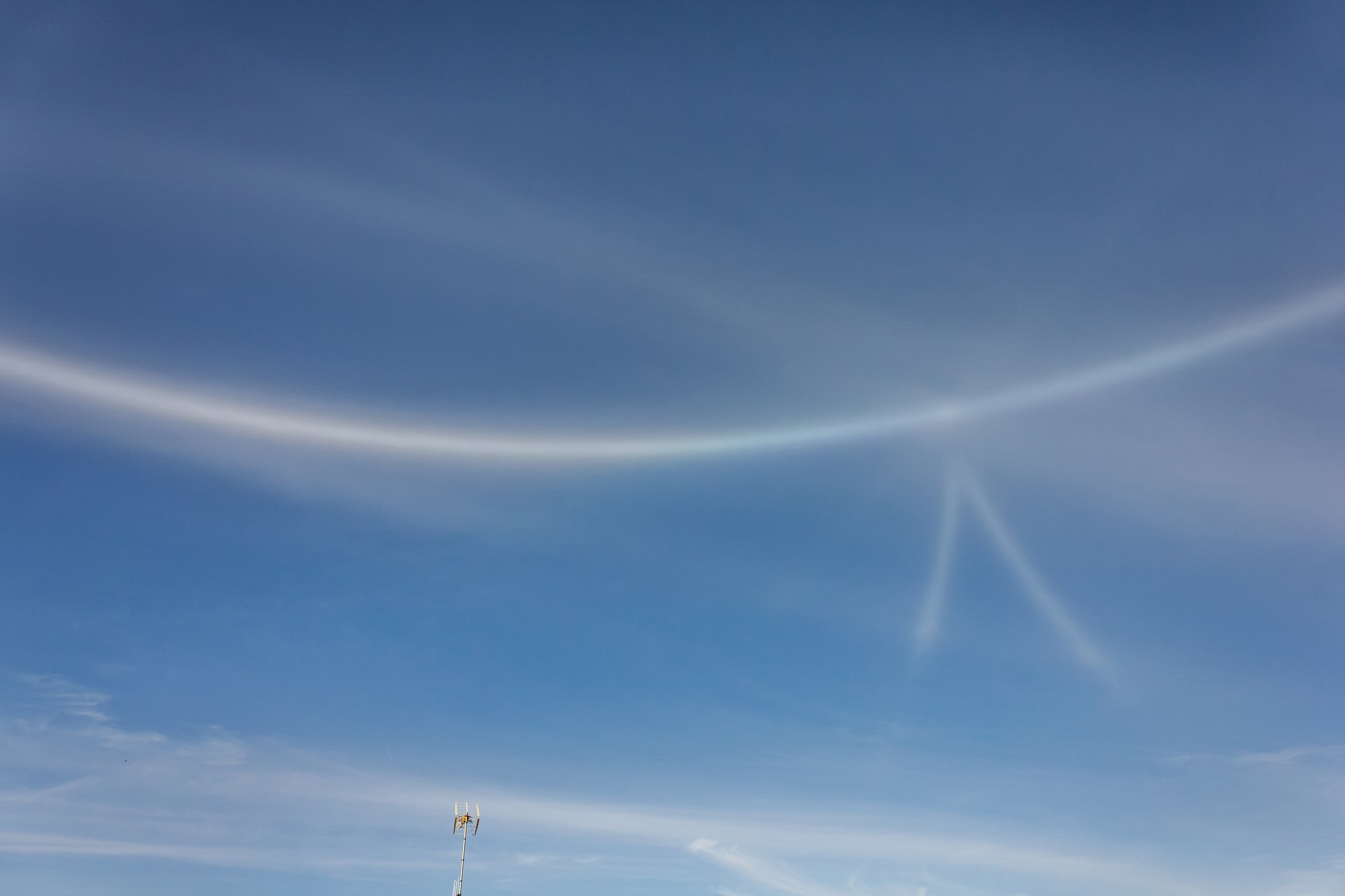
around 14:41 CET Parhelic circle with Wegener's anthelic arcs forming an X at the antisolar point, and Tricker's anthelic arc as an inverted V (Photo: Paul Reed)
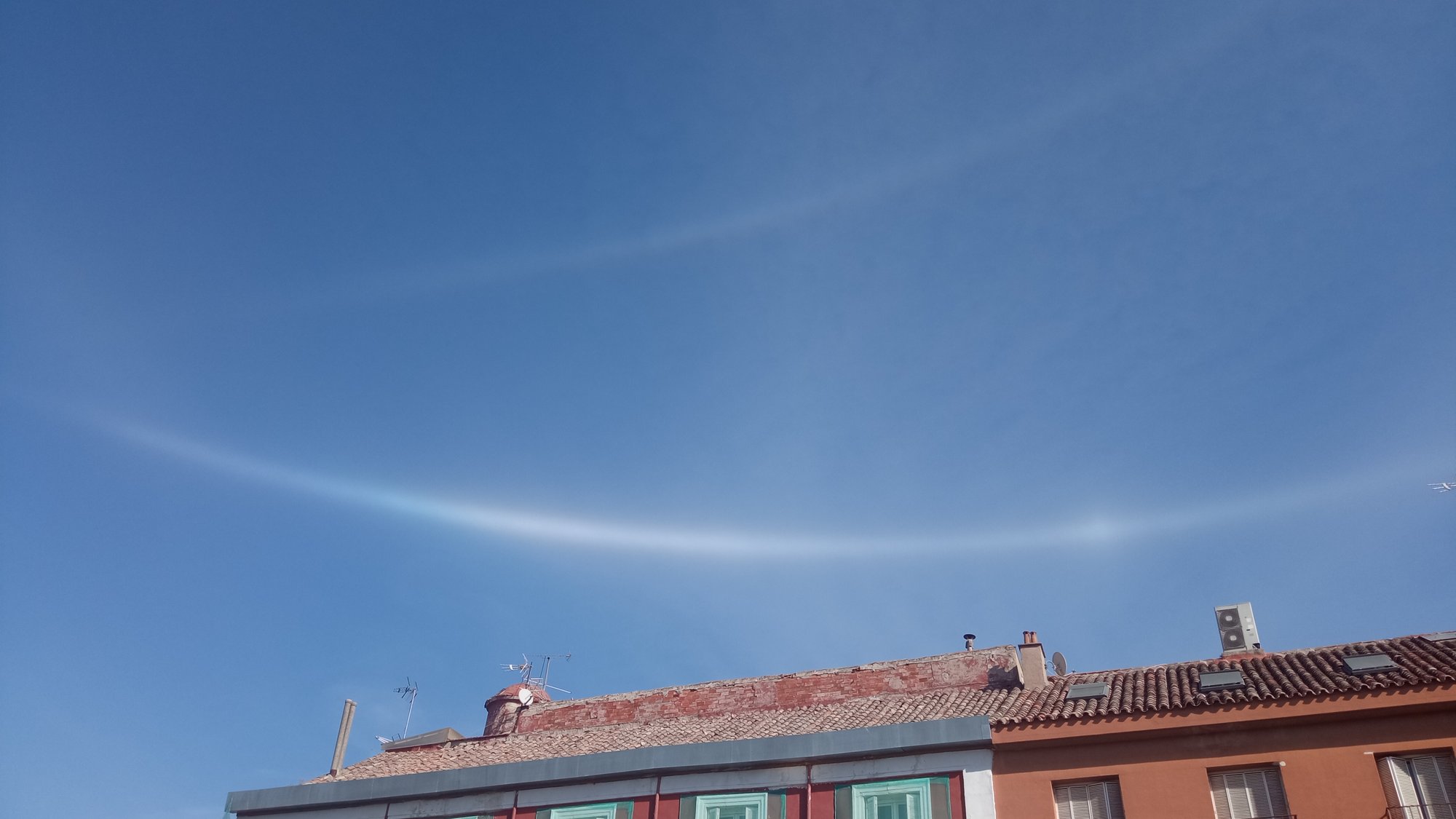
14:54 CET Wegener's anthelic arc at the top, below it the parhelic circle with 120° parhelion and Liljequist parhelion, which is strikingly blue towards the antisolar point (Photo: Paul Reed)
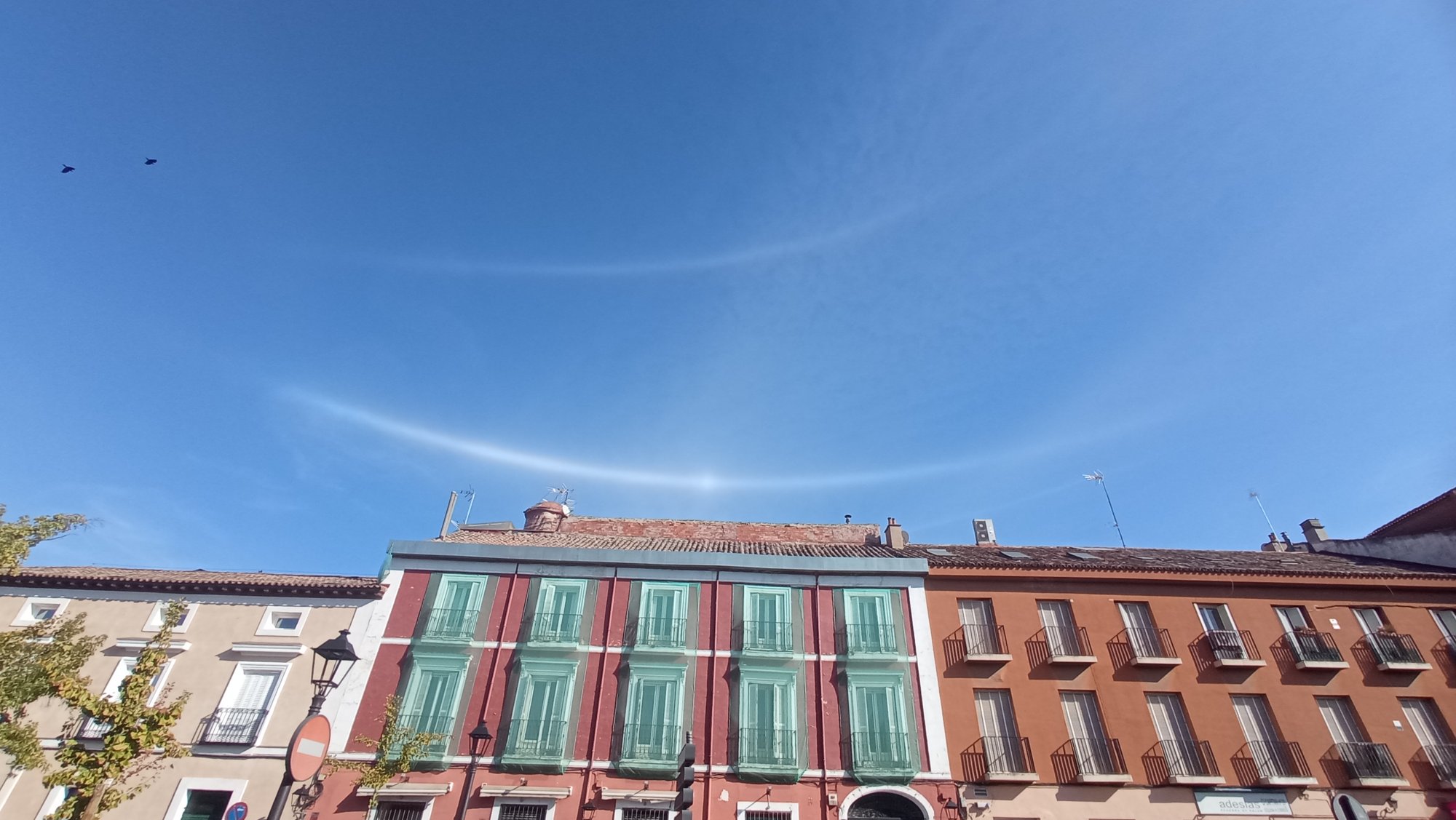
14:58 CET Parhelic circle with 120° parhelion and Wegener's anthelic arc above the houses of Aranjuez (Photo: Paul Reed)

around 14:59 CET Complex halo display with many halo types, taken with a fisheye lens (Photo: Paul Reed)

15:01 CET Circumzenithal arc surrounded by the heliac arc, with upper tangent arc and Parry arc above the sun (Photo: Paul Reed)
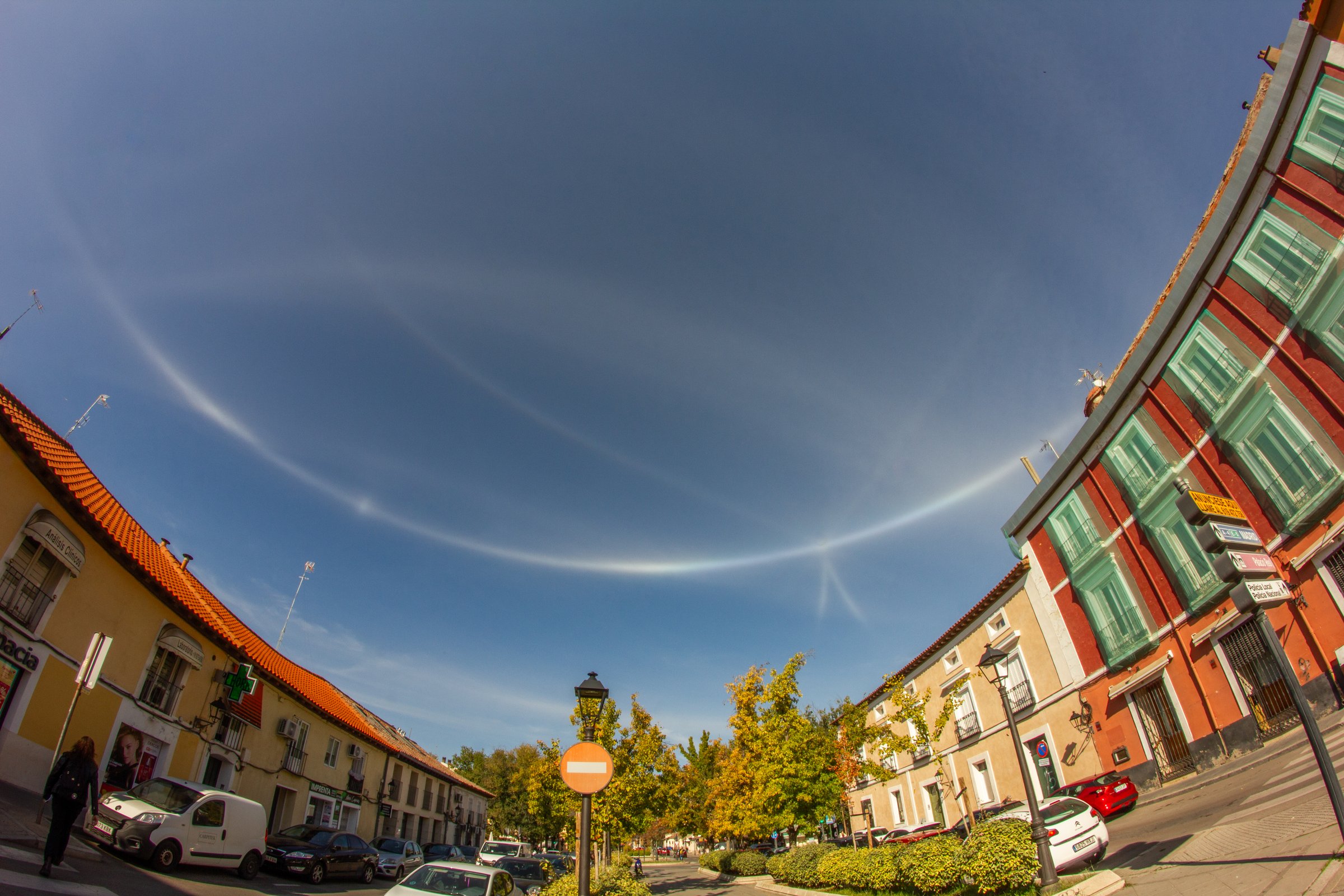
around 14:47 CET Antisolar side with parhelic circle, 120° parhelion, Liljequist parhelia and several anthelic arcs (Photo: Paul Reed)