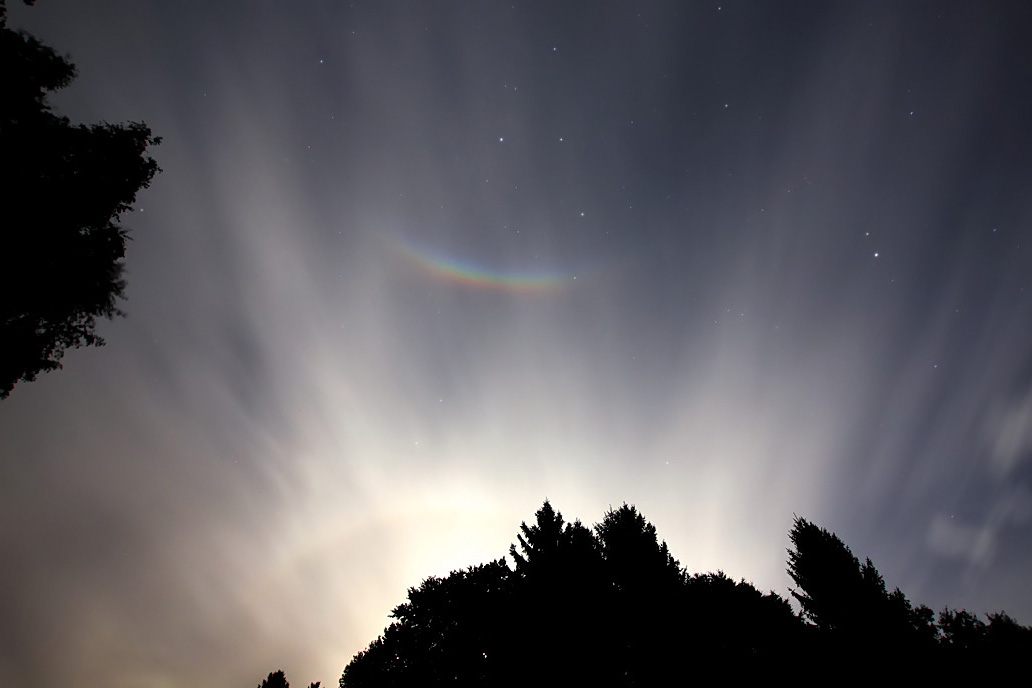
The circumzenithal arc (abbr. CZA) is one of the most beautiful and colorful halo phenomena. Its coloration and brightness can match, or even surpass, the
rainbow. Thus, it has often been mistaken for a rainbow. Unlike the rainbow, which forms a circle around the sun's antipoint, the circumzenithal arc is an arc around the zenith, with only the part facing the sun visible. Normally about a quarter of a circular arc is visible, in exceptional cases a semicircle. Red lies on the lower side facing the sun, violet towards the zenith. Pure, well separated colors are typical. At the typical solar heights between 15° and 25°, its apex lies about 46° above the sun. With a lower or higher sun it is somewhat farther away. At a solar height of 32°, the circumzenithal arc disappears at the zenith. When the solar height is over 32°, it can no longer form. In summer it is therefore only visible in the morning and evening, in winter throughout the day. The circumzenithal arc reaches its greatest brightness at a solar position of 22.1°. Therefore, it is most often seen at a solar position between 15° and 25°. It is often taken for an upside down rainbow. The
supralateral arc and the
46° ring touch the circumzenithal arc and can be confused with it. Around the moon the circumzenithal arc is rare because it requires a bright moon.
The circumzenithal arc is formed just like the
sun dogs on
horizontally floating ice plates. Here, however, the light enters at the base surface of the plate and exits at a side surface. Since the side surfaces are perpendicular to the base surface, the refracting angle of the prism is 90°. If sun dogs are visible, there is a high probability, especially when the sun is between 15° and 25° high, that the circumzenithal arc can also be seen. Unfortunately, the circumzenithal arc is hardly known to anyone, even though it occurs almost as frequently as the rainbow. The main reason for this is probably that one has to look almost straight up to see it.