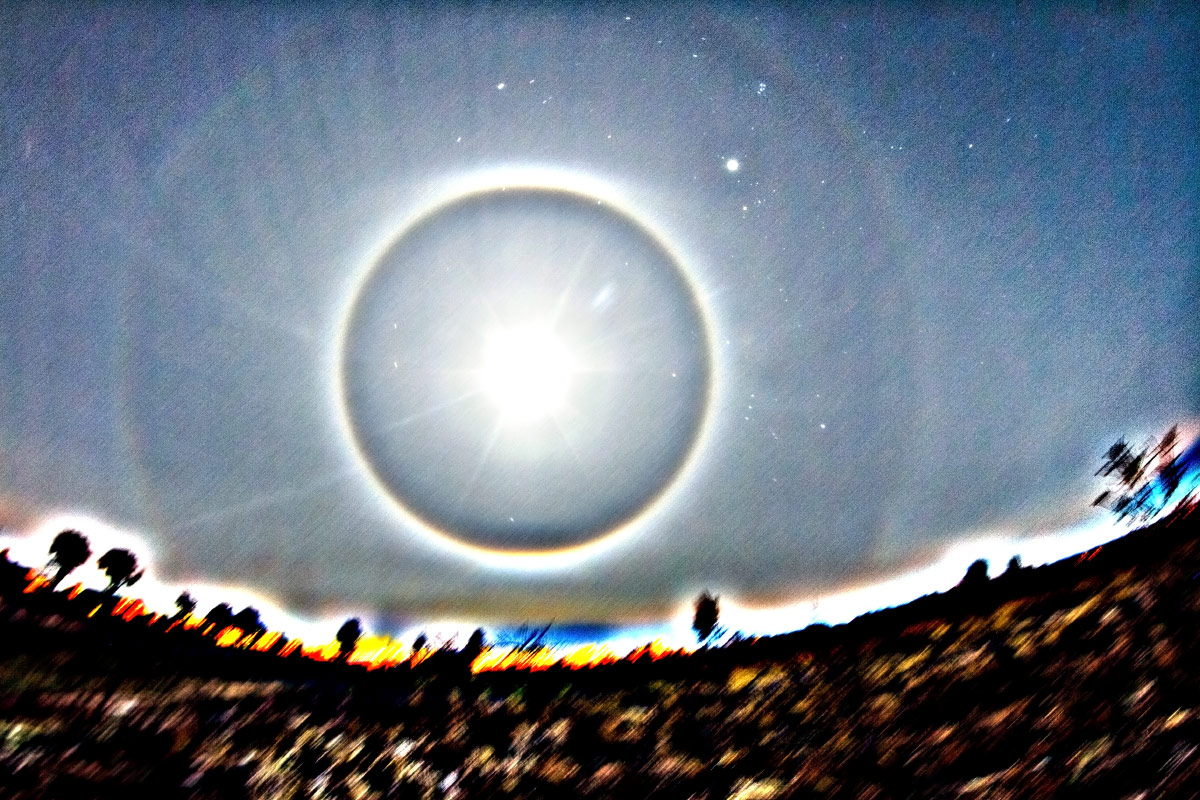
The 46° ring, also called the great ring or 46° halo, is a circle of light with a radius of 46°, with the sun at its center. It is wider than the
small 22° ring, but also much dimmer. Its colors are pale. It is reddish on the inside, while green and blue are hardly visible. The 46° ring accounts for only about 2% of all halo phenomena. At a solar altitude between 15° and 27°, there is a risk that it may be confused with the
supralateral arc. In fact, many sightings of the 46° ring seem to involve parts of the supralateral arc. If a
circumzenithal arc touches the arc at solar altitudes well below 15° or above 27°, it is the supralateral arc.
The 46° ring is formed by
randomly oriented ice crystals, with the refracting angle being 90°. The light enters through one prism face of the crystal and exits through a base face. This requires compact crystals such as short columns with intact base faces. That is why the 46° ring is much rarer than the 22° ring. The exact radius is about 45.7°. This is the minimum deviation for a refracting angle of 90°.