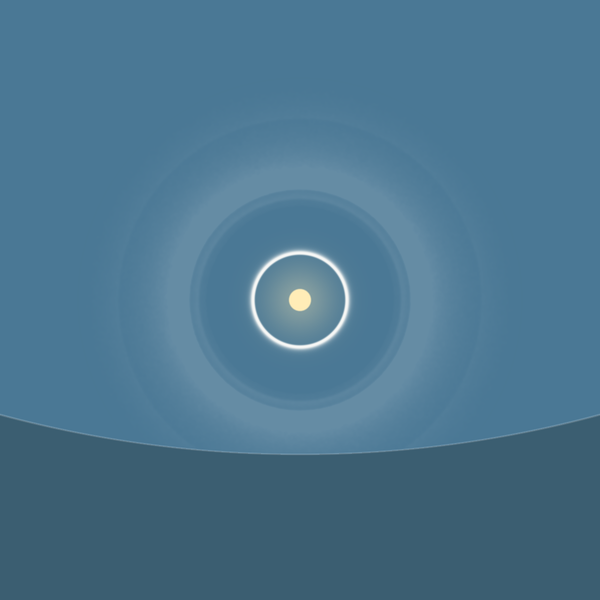
The 9° ring is a faintly colored ring of light with a reddish inner edge and a radius of 9° around the sun. It can also be observed around the moon. It often occurs along with other halos produced by pyramidal crystals. However, it is rare for there to be enough pyramidal crystals to produce halos. Since the ring is quite close to the sun, it is difficult to see. Furthermore, it can easily be mistaken for
corona phenomena. Unlike a corona, the 9° ring has a fixed radius and no repeating colored rings. The 9° ring is the
first inner ring of the rings produced by pyramidal crystals. It is also called van Buijsen's halo. Pyramidal crystals with a vertical main axis also produce the
9° Parry arcs.
The 9° ring arises from
randomly oriented pyramidal crystals. It is created by light that passes through a prism face and an opposite pyramidal face at the other end of the crystal. The two faces enclose an angle of 28°. The pyramidal faces of these crystals are inclined by 28° to the crystal axis.