Description
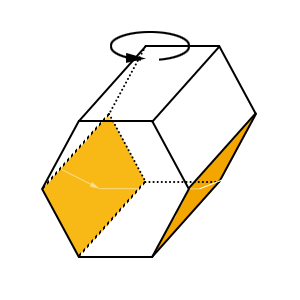
For each appearance of the parry arches, there are different light paths. The simulation shows the upper concave and upper convex parry arch together.

Crystal Type:
- Columnar Crystals
- doubly oriented
- Refraction on 2 side faces
Occurrence:
- quite rare (2-6 days a year)


EE27A - Upper Concave Parry Arc


EE27B - Lower Concave Parry Arc


EE27C - Upper Convex Parry Arc

EE27D - Lower Convex Parry Arc
The parry arc changes its shape with the sun's altitude. It is mainly observed at solar altitudes between 15° and 40°. Then it appears as a concave arc between the two branches of the upper tangent arc or above the circumscribed halo. At low solar altitudes, the upper convex Parry arc also appears. It is formed by a different light path, lies just above the upper tangent arc and disappears above a solar altitude of about 16° to 20°. The parry arc is a relatively faint colorful arc. Towards the sun, it is orange-red and slightly bluish on the outside. When the sun is very low or very high, the parry arc becomes so faint that it can hardly be seen. Below the sun there are two Parry arcs: the lower convex Parry arc from a solar altitude of about 25° and the lower concave Parry arc from about 50°. The lower concave Parry arc lies below the 22° halo and touches it at a solar altitude of about 71°. Whenever an exceptionally bright tangent arc or circumscribed halo is visible, there are good chances that the parry arc will also appear. The concave Parry arc differs from the upper tangent arc by its curvature, which opens towards the sun, just above the tangent arc. The arc is named after William Edward Parry, who observed it on 8 April 1820 on Melville Island during his Arctic expedition.
Simulation
Betätige den Slider, um die Sonnenhöhe zu ändern.
Origin
For the formation of the Parry arc, the ice crystals must be double-oriented. Double-oriented means that not only is the main axis of the columnar crystals oriented horizontally, but additionally the upper and lower prism faces are aligned parallel to the horizon. Crystals with such orientation are rarely found in large numbers. The path of light corresponds to the upper tangent arc. For the upper concave Parry arc, the light enters the upper horizontal prism face and exits through the alternate prism face, which is inclined downwards. The other Parry arcs are formed at other pairs of faces that also enclose an angle of 60°. Crystals in Parry orientation produce further halos, for example Parry arcs by reflection and Tape's arcs.
Photos
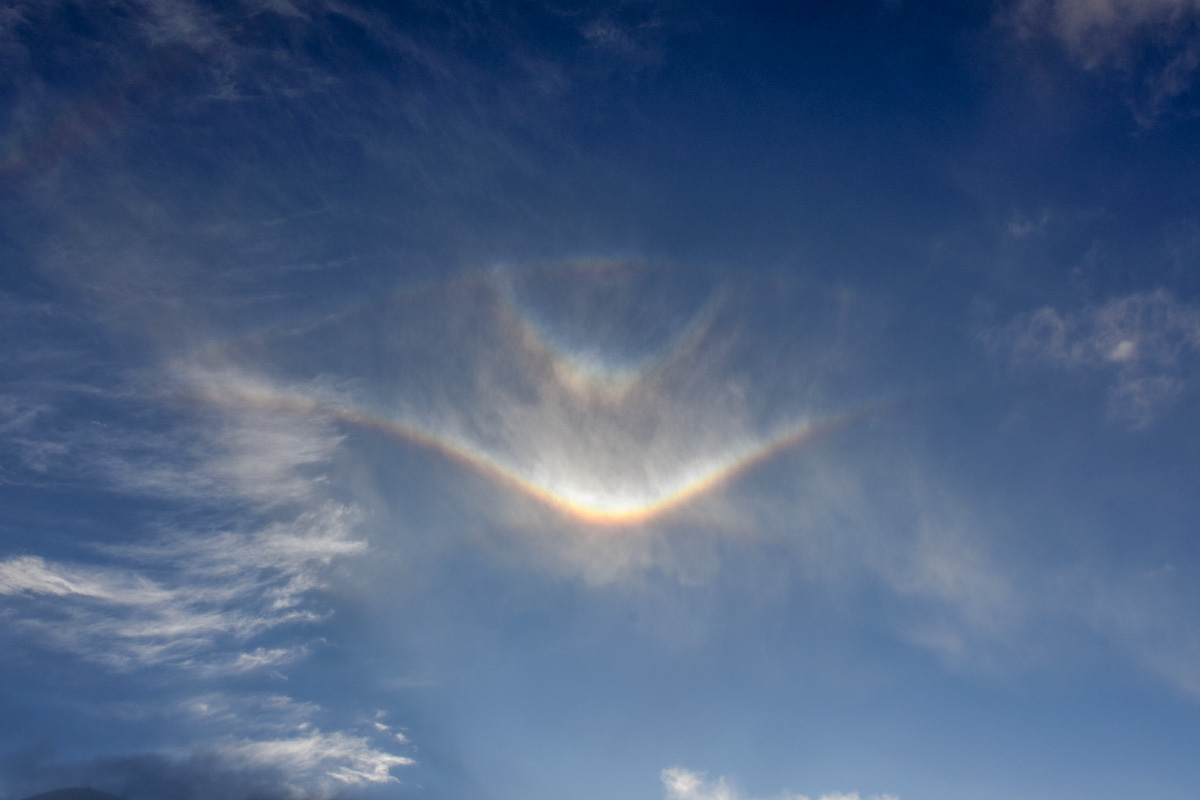
Concave and Convex Parry Bow on 07.11.2017 in Davos (Photo: Bertram Radelow)
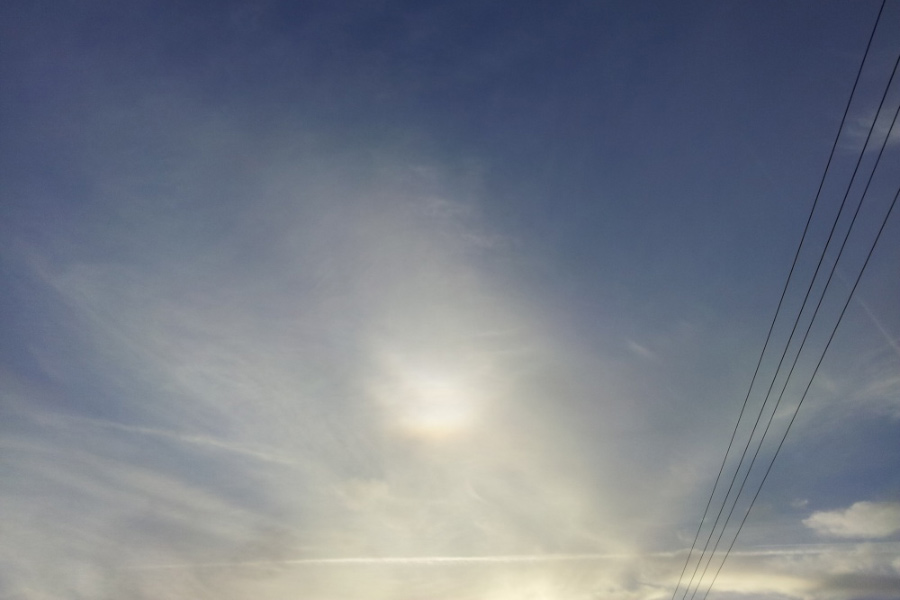
Upper convex Parry bow taken on 11.11.2013 in Limburg (Photo: Gerrit Rudolph)
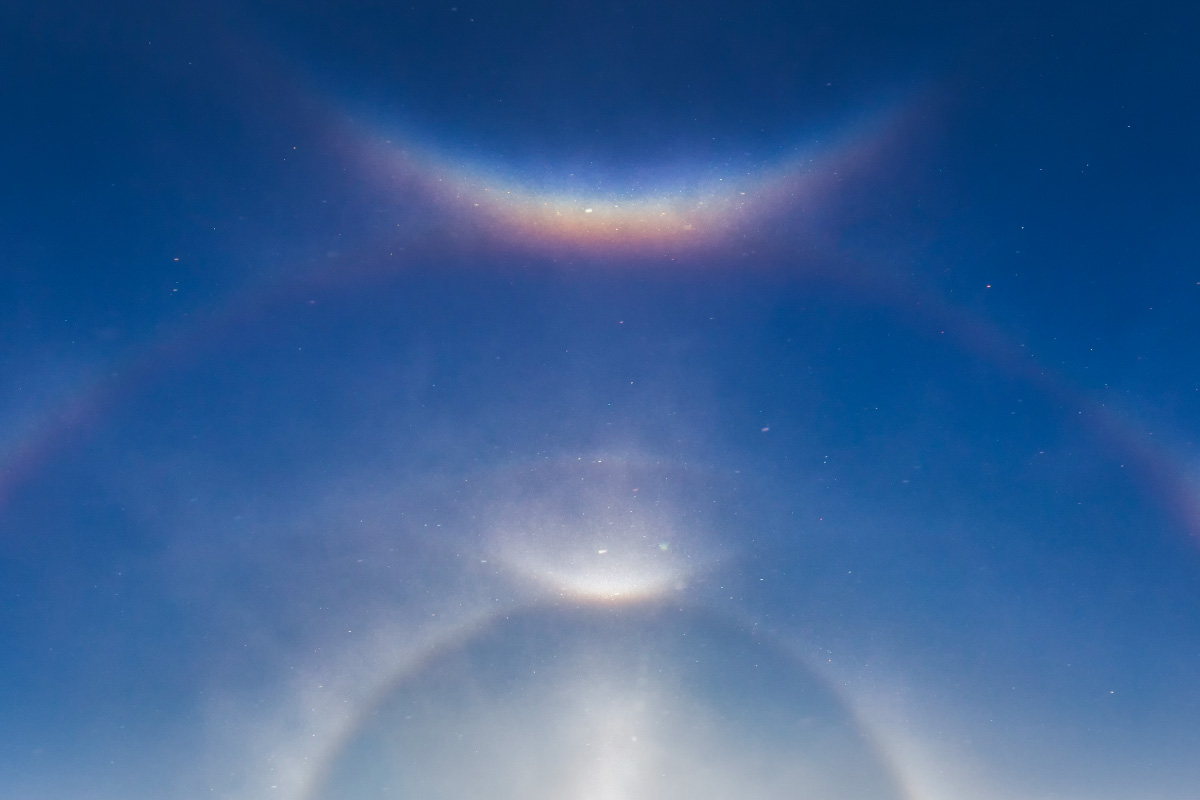
Convex parhelic circle in ice fog near Jena (Photo: Marco Rank)