Description
The origin of Bottlinger's rings has not yet been fully clarified.

Crystal type:
- unknown
- unknown
- unknown
Occurrence:
- very rare
Bottlinger's rings are related to the Elliptical Rings and resemble them in appearance. However, Bottlinger's rings are located immediately near the subsun. Since the rings surround the subsun and therefore lie below the horizon, they can only be seen from an aircraft, from a balloon or from mountain tops above the clouds. They are very rare and often visible for only a few seconds. The rings are vertically elongated ellipses a few degrees in size. They are named after the astronomer Kurt Felix Bottlinger, who observed them around the subsun on 13 March 1909 during a balloon flight above an ice cloud.
Origin
Bottlinger's rings, alongside the elliptical halos with which they seem to be related, remain an open problem in halo theory to this day. Diffraction is not a valid explanation, as the rings would otherwise have to appear colored. An older explanatory model assumes reflection on pendulum-like or spinning crystals during their fall. The resulting different inclinations of the surface deform the ideal sun mirror image, i.e., the subsun, into a ring. In the late 1990s, plate crystals with very flat pyramid-like tops were postulated as the cause. Simulations for various internal and external reflections yield sufficiently plausible results when compared with photos. They require very precisely horizontally aligned crystals. However, it is still unclear how the extremely flat pyramid angle could arise from the crystallization properties of ice (unlike the flank angle of the pyramidal halos). So far, it is treated as a free parameter, varied until the best possible match with observations is achieved. It may be more complicated crystal forms, e.g., six-pointed stars with a thickened central area.
Photos
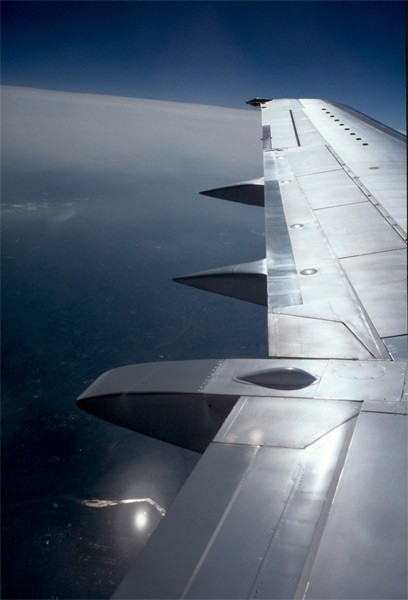
Bottlinger's Ring taken from an airplane on 15.04.1997 (Photo: Frank Wächter)
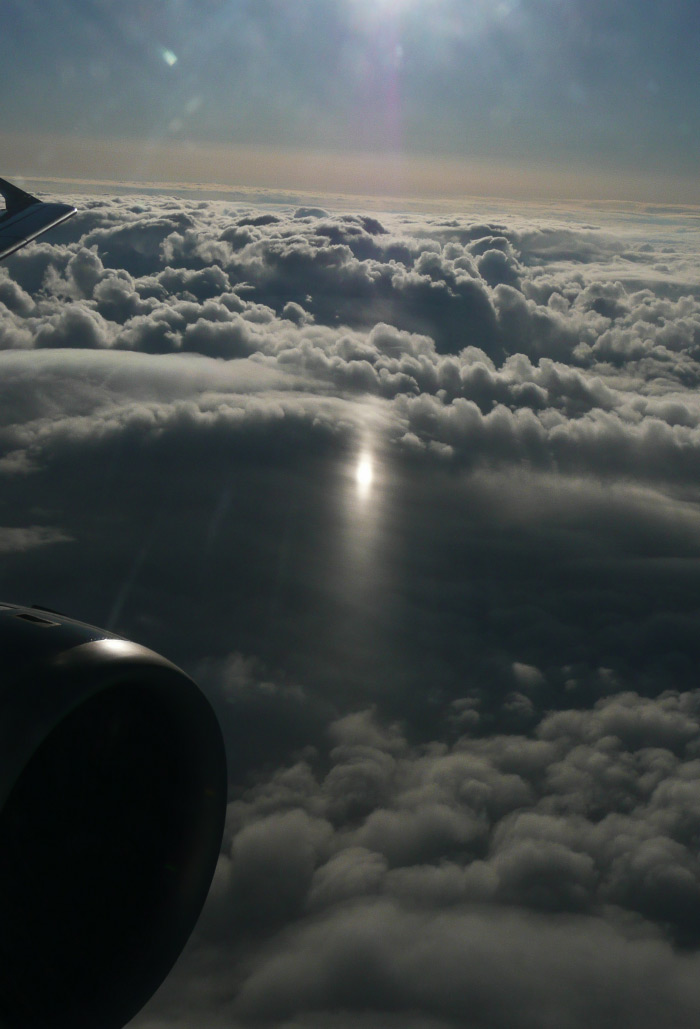
Bottlingers Ring taken from the airplane (Photo: Andreas Zeiske)