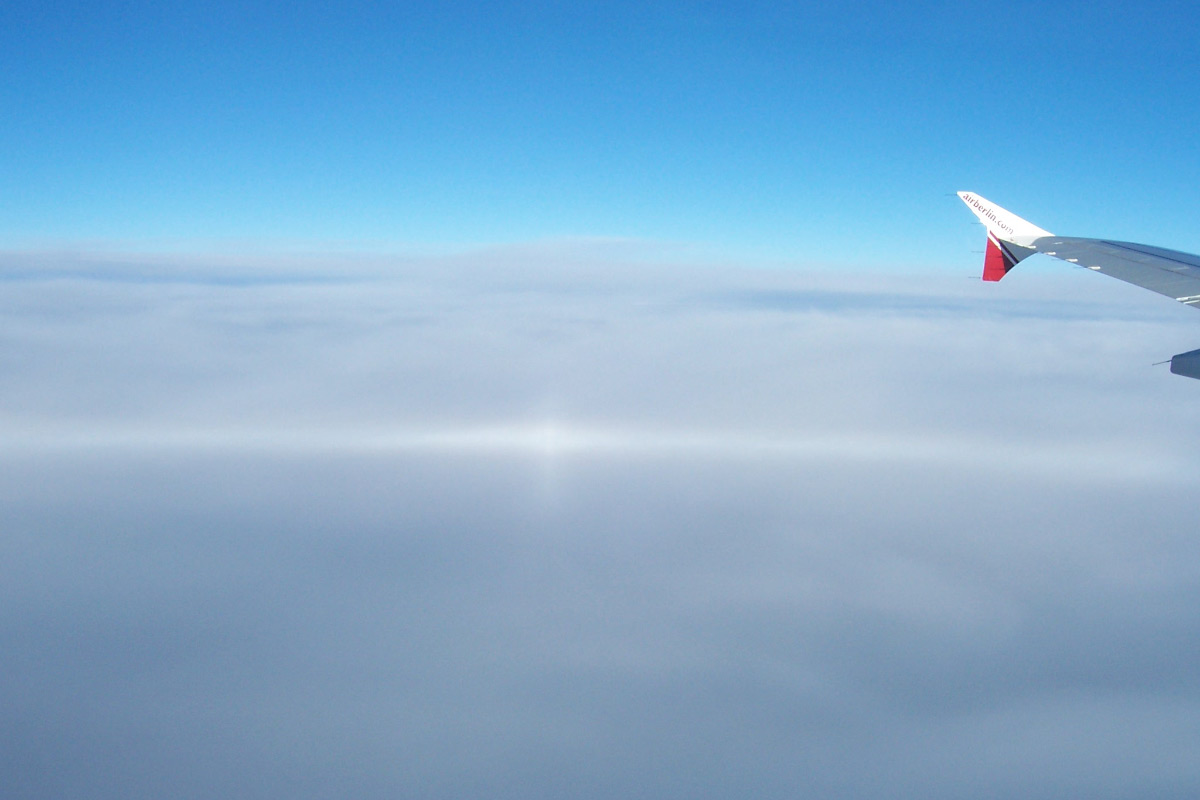
The subhorizon circle is a white circle of light that runs parallel to the horizon at the level of the
subsun. It is white because it is mainly produced by reflections. In
contrast to the
horizon circle, the subhorizon circle is located exclusively below the horizon. It can therefore only be observed from mountains or from an aircraft. Observations are correspondingly rare. The Liljequist subparhelia (EE29), the subanthelion (EE30) and the 120° subparhelia (EE74/75) all lie on the subhorizon circle.
In
oriented plate crystals, multiple light paths with internal reflections are possible, contributing to the subhorizon circle and whose overall superposition provides a realistic image of this halo type. Also involved are light paths similar to the Liljequist parhelia, which is why the term "Liljequist subparhelia" appears in the literature. In contrast to the horizontal circle above the horizon, there are hardly any intensity contributions to the area between the
subparhelia, i.e., left and right of the sub-sun. Thus, the subhorizon circle has a gap there. To a lesser extent, parry-oriented column crystals can also contribute to the subhorizon circle.