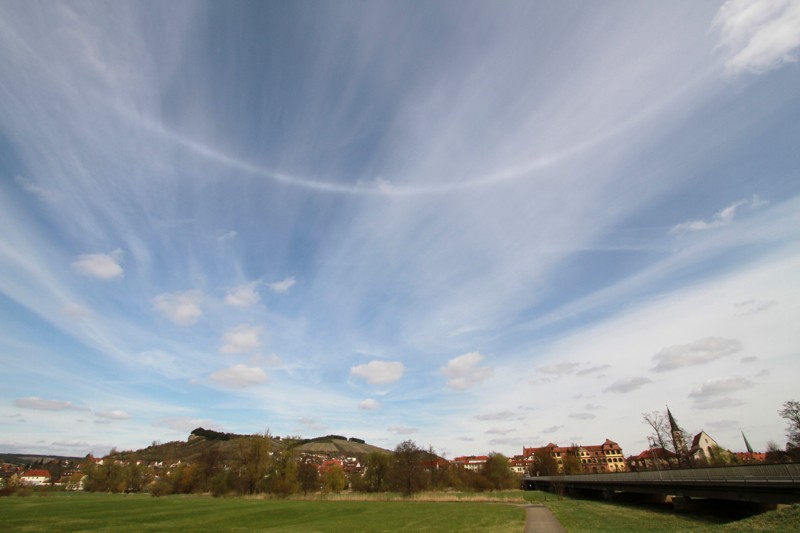
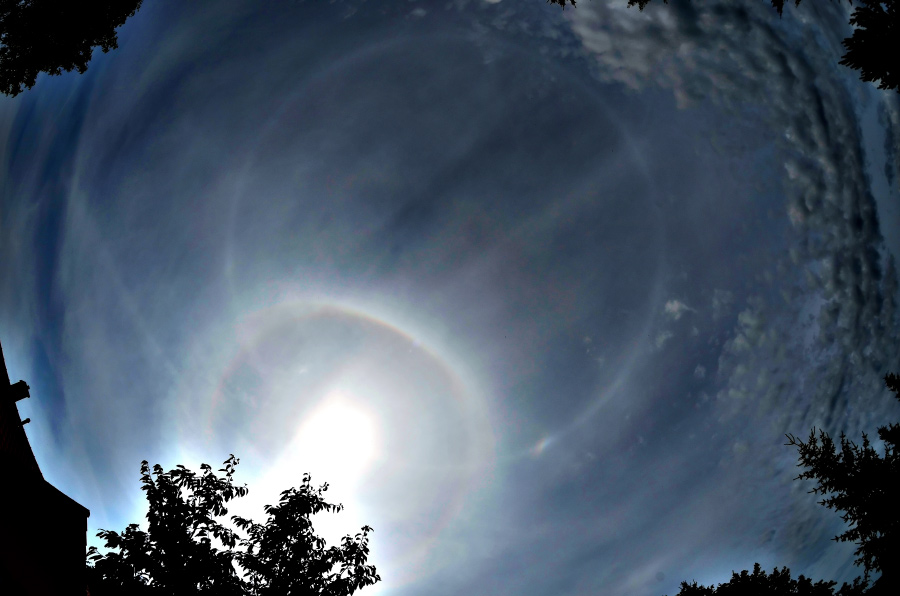
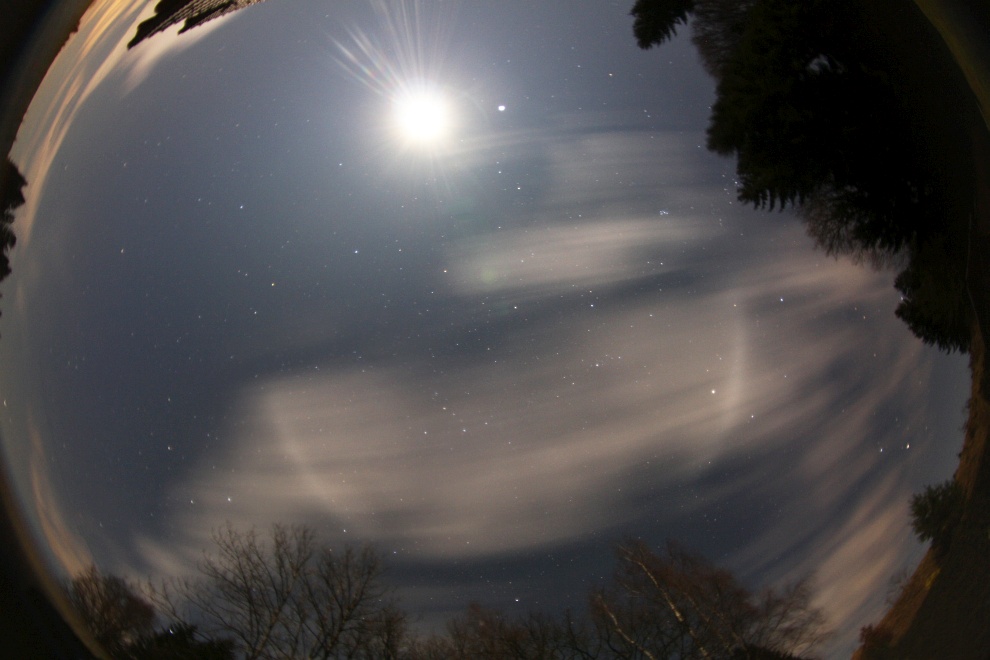
The horizontal circle is a white circle of light that runs parallel to the horizon at the height of the sun. It is also referred to as a parhelic circle or sun dog circle, as the
sun dogs lie on it. It is a reflection halo, which is why its color matches that of the sun. A complete horizontal circle is very rarely seen because the ice crystals must cover a large part of the sky for it. Often only fragments are visible that extend horizontally from the sun dogs. It is worth looking for it on the side of the sky opposite the sun as well. Further halos can lie on the horizontal circle, such as the
120° parhelia, the Liljequist parhelia and the
anthelion. Strictly speaking, the horizontal circle is a small circle around the zenith. It therefore appears strongly curved when the sun is high.
The horizontal circle is mainly formed by the reflection of sunlight on the vertical surfaces of ice crystals. For
floating plates, these are the prism surfaces, and for floating columns, the base surfaces. In addition, many other light paths are possible. One is mentioned here as an example: In plates, there is an internal reflection on the prism surface. The light enters through the upper base surface, is reflected on the prism surface, and exits through the lower base. The refraction of light upon entry and exit cancel each other out, so there is no color separation.