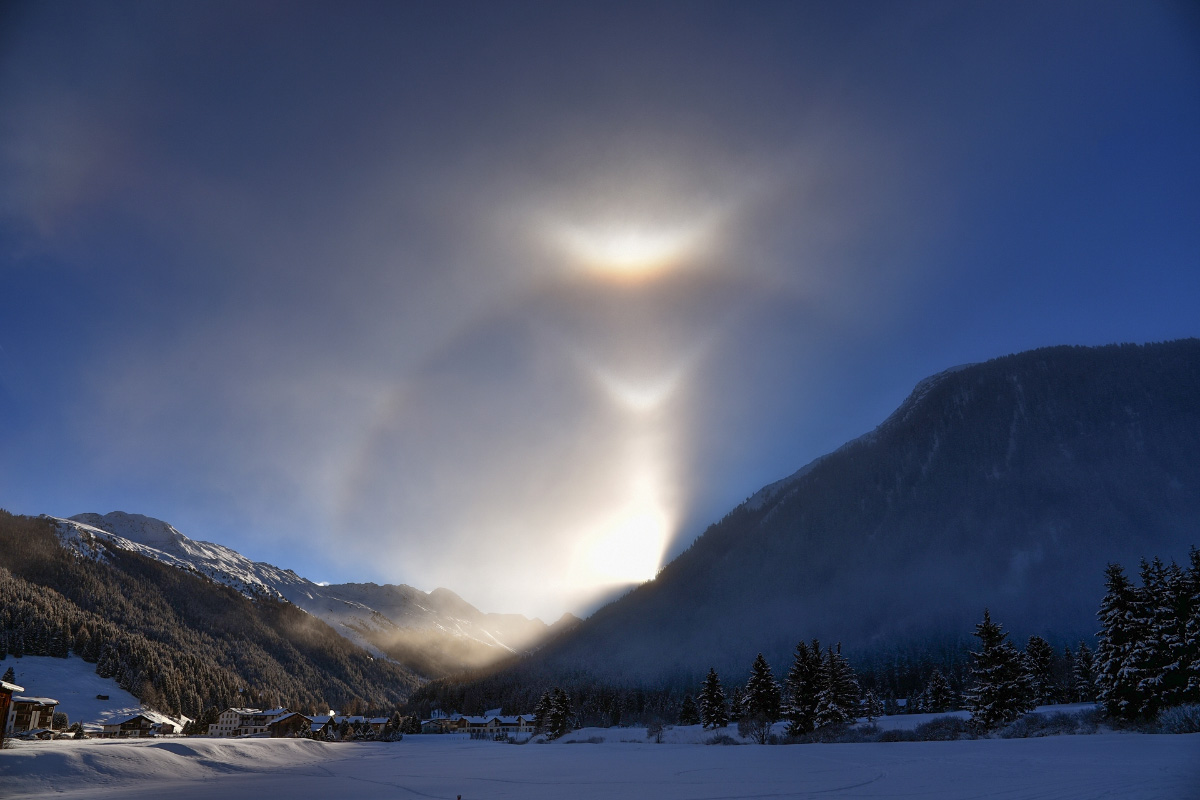
The Moilanen arc is a white arc in the shape of a V. It lies about halfway between the sun and the
upper tangent arc. Its distance from the sun changes with the solar altitude.
As early as 1975, Horst Gäbler (1921-2014) sketched an arc on the Fichtelberg in the Ore Mountains as part of an ice fog halo that was V-shaped approximately 10° above the sun. A photo taken by Jon Nickles in Anchorage, Alaska, in 1978 was later also identified as showing this arc. In November 1995, the Finn Jarmo Moilanen was finally able to photograph and measure this arc, which was later named after him. Karl Kaiser observed a similar arc in diamond dust in Schlägl, Upper Austria, on January 30, 1997. To this day, this phenomenon remains a mystery, mainly because the corresponding crystal form apparently occurs only in ice fog. The arc has not yet been reliably detected in cirrus clouds. Moreover, this crystal does not seem to produce any other "exotic" halos, as is the case with pyramidal ice crystals, for example.
For a long time, it was assumed that it occurs exclusively on ice crystals that have grown from the condensation nuclei of snow cannons. Some snow cannons add ice nucleating proteins to the water, on which ice crystals form. It is assumed that under optimal conditions this can produce crystals that occur in nature only rarely or not at all. Meanwhile, there are few observations from areas without snow cannons, such as on January 25, 2012 in Achsheim or on January 21, 2016 in Bremerhaven on the North Sea coast.
During the occurrence of the Moilanen arc, multiple searches for possible causative ice crystals were conducted, but without conclusive success so far. In the meantime, the arc can be simulated with a wedge-shaped crystal form with an inclination angle of 34°. However, it is questionable whether this crystal form occurs in nature and whether it can float stably in the air with the required horizontal wedge edge. Several crystal models have been proposed, such as twinned plates or crystals grown together. None of them has yet been confirmed by crystal samples. A lower Moilanen arc has never been observed, which rules out many crystal models. When the sun is very low, a reflected lower
Parry arc can appear at a similar position and be mistaken for the Moilanen arc. Thus, the cause of the Moilanen arc is still not determined.