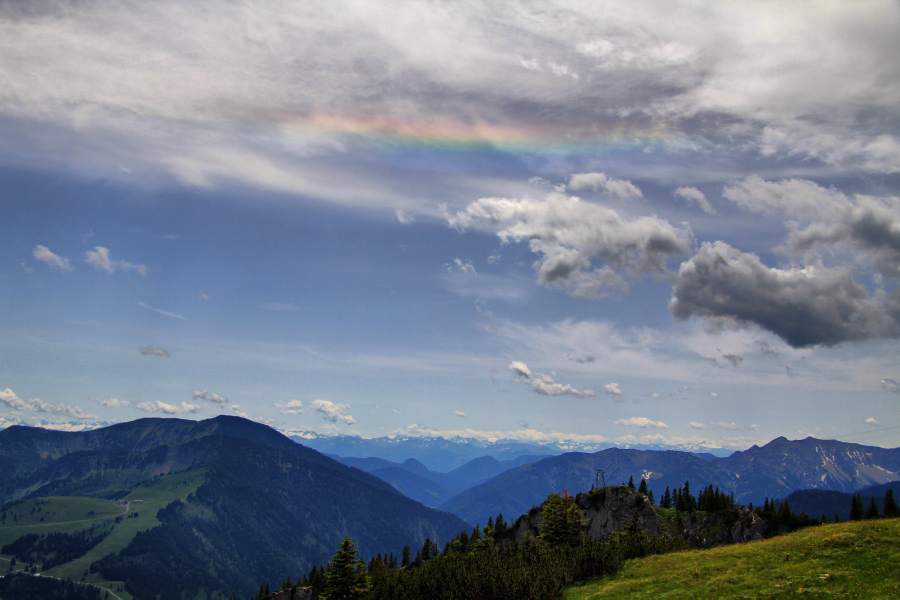
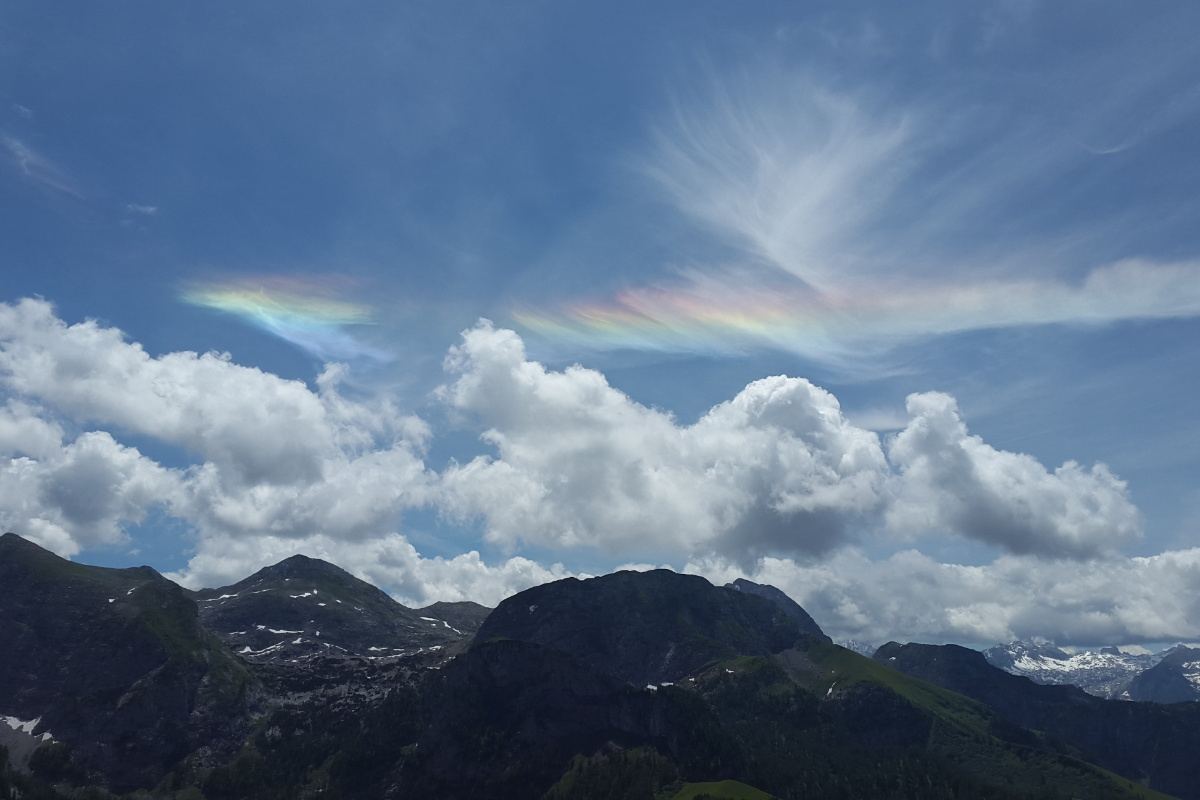
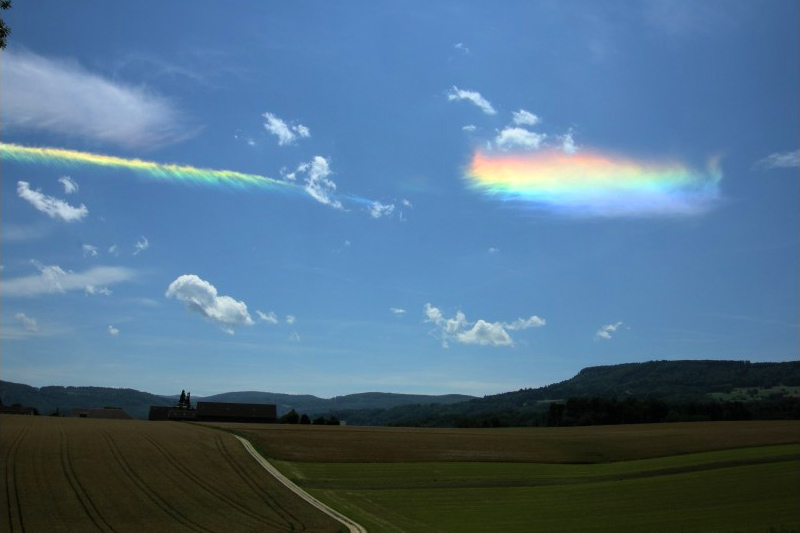
The circumhorizontal arc (abbr. CHA) corresponds in its colorfulness and brightness to the
circumzenithal arc. However, the sun must be very high for it to be visible. Only from a sun height of 57.8° does the arc appear as a colorful band on the sunny side of the horizon. With the sun, the circumhorizontal arc also rises and reaches its maximum brightness at a sun position of 67.9°. The arc runs parallel to the horizon about 46° below the sun. Red is on top. Often only individual cirrus clouds light up in its colors. In summer, the sun in Germany reaches a height of about 59° in the north and up to 66° in the south. Therefore, the circumhorizontal arc can only occur here at midday on quite a few days of the year. It has only been observed a few times by us. If you travel to countries further south during the summer vacation, you have a better chance of seeing this impressive halo phenomenon. North of about 55.6° north latitude, the sun never reaches a height of 57.8°. The circumhorizontal arc cannot form there. The same applies south of about 55.6° south latitude. Thus, it is one of the few halo phenomena that cannot occur everywhere on Earth. Observing from high mountains does not change this, because the condition depends only on the solar altitude. A circumhorizontal arc of the moon is possible but very rare, because the moon is rarely high enough during a bright phase.
The following table shows when a possible circumhorizontal arc can be observed in which German city. The time periods are guidelines.
The circumhorizontal arc, like the circumzenithal arc, forms in
floating plates. In this case, however, the light enters a vertical side face and exits through the lower horizontal base surface. If the sun is lower than 57.8°, the light is totally reflected at the lower base face and cannot leave the crystal there. The
infralateral arc always touches the circumhorizontal arc.