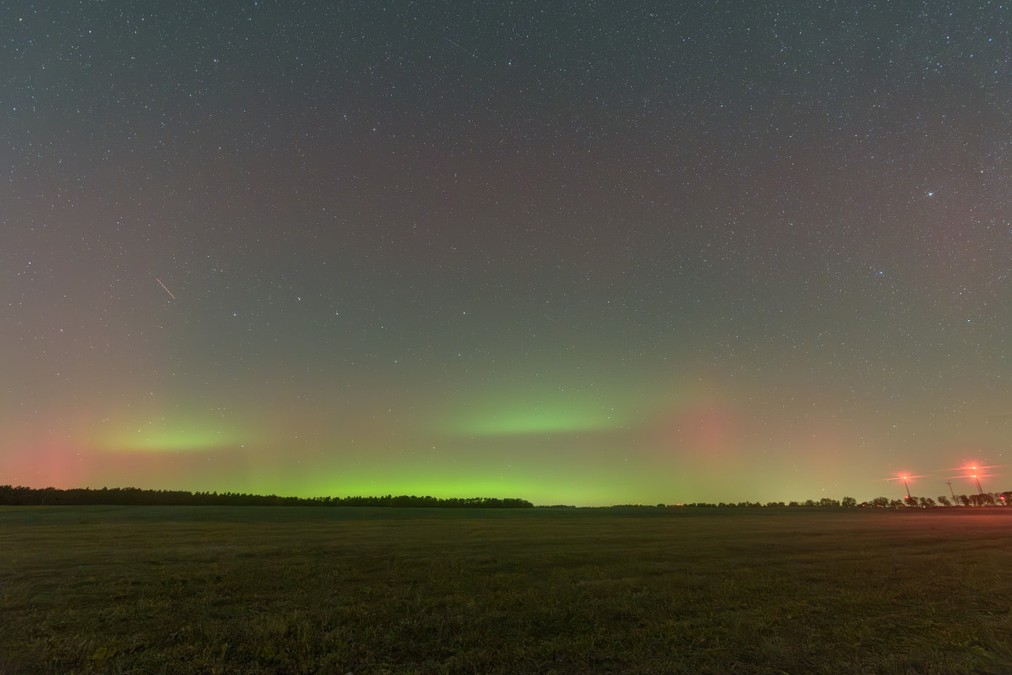
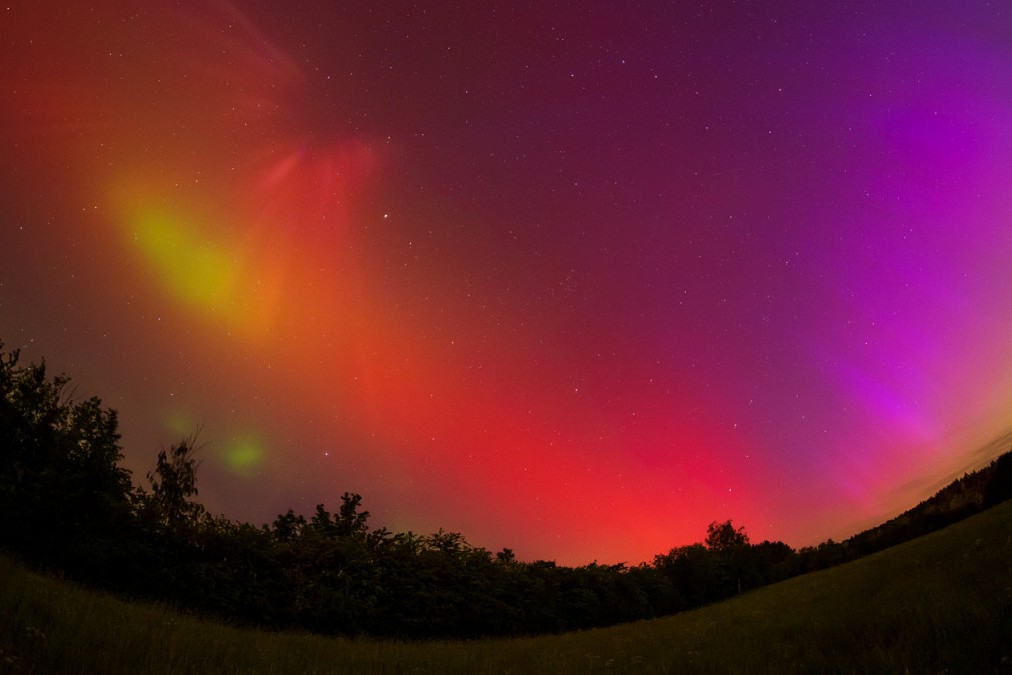
Aurorae can be seen in Germany far more often than most people think. In 2025, aurora was recorded in Germany on 94 nights. The archive of aurora sightings in Germany has never counted so many nights in a single year. Many of these displays were faint and only visible in photos. During strong geomagnetic storms, however, the sky glows red and green as far as southern Germany.
A reliable aurora forecast is not possible, not even several days ahead. However, an understanding of the processes between the Sun and the Earth allows the current data to be interpreted correctly. This page explains the decisive parameter, refers to the real time data and describes the relationships.
The decisive factor for aurora in Germany is the Bz component of the interplanetary magnetic field. When Bz is negative, i.e. directed southward, the solar wind couples to the geomagnetic field through magnetic reconnection. Only then do geomagnetic storms and aurora develop. Satellites measure Bz about 30 to 60 minutes before the solar wind reaches the Earth.
Typical values during aurorae in Germany:
- Bz around −5 nT: Faint aurora is visible in northern Germany.
- Bz around −10 nT: Visual aurora is possible all over Germany.
- Bz around −15 nT: Aurora may be visible as far south as Bavaria and the Alps.
- Bz around −20 nT: Bright substorms can occur.
- Bz below −30 nT: The aurora can become very bright.
Bz should remain negative for at least one hour. The Kp index, in contrast, only describes the disturbance of the past three hours and is not suitable for assessing the current situation.
The following eight steps describe the path from an eruption on the Sun to the aurora over Germany. Each step contains matching real time data and examples of past events.
In Germany, aurora is often only visible for a short time. The following services provide timely alerts: